Episode Transcript
[00:00:07] Speaker A: Get a Jason Genesis.
Hot sun Sitting down yeah Burning my feet Just walking around Hot sun get it, Jason. Making me sweat Genesis Gator's getting close.
[00:00:24] Speaker B: Help got up the air I can.
[00:00:28] Speaker A: Dance I can talk Everything about me is the way that I walk okay, go ahead, Jason.
[00:00:36] Speaker B: All right. Welcome to the weekly Deep Dive podcast on the Add on Education Network.
The podcast where we take a look at the weekly Come follow me discussions and try to add a little insight and unique perspective. I am your host, Jason Lloyd, here in the studio with my friend and the show's producer, Nate Pifer.
[00:00:54] Speaker A: DJ Nate Pifer.
[00:00:55] Speaker B: DJ Nate Piper.
[00:00:56] Speaker A: Speaking of Genesis lover.
[00:00:57] Speaker B: Spinning us up some Genesis.
[00:01:00] Speaker A: Except for everybody. Genesis.
[00:01:02] Speaker B: I was kind of hoping it would be like a Nate Pifer cover.
[00:01:05] Speaker A: I didn't have. I was honestly gonna try to do something of that this week, but I have been swamped with work, and so I'm sorry I wasn't able to make it happen.
[00:01:13] Speaker B: No, it's all good. In fact, this week, there's so much content. I'm really excited. We are talking about the flood, Noah, the ark. What were the people like before the flood?
We are going to be talking about the weird story of Noah building a vineyard, getting drunk, and some weird voyeurism with his son and his cursing of his grandson. What's that all about?
[00:01:39] Speaker A: Let's do this.
[00:01:40] Speaker B: Yeah.
And then we get to wrap it up with a discussion about the Tower of Babel. So that's okay. If our focus is going to be on content this week, let's focus on the content.
[00:01:50] Speaker A: I have actually put in quite a bit more effort than I usually do of trying to help prepare to have some better ideas this week than I have in some of the passes, because the new test or the Old Testament has stoked me. Dude, it's lit a flame.
[00:02:05] Speaker B: It's been fun. And we keep hitting these recurring themes.
We said it at the beginning of the year when we introduced the Old Testament.
The Old Testament has more references to atonement than any of the other scriptures that. That we've been studying.
And not only do we see it blatantly as we'll get into the law of Moses and we'll see about redeemer of blood and atonement and how that all plays out. But I hope you guys, Nate and I were just talking on the way over here how much we see this play out. I mean, just a quick recap. When we talk about Adam and Eve and their nakedness being covered, atoned for, and we talk about City of Enoch as this idea of restoration of Enoch, making it back into paradise, if you will. And we are going to see even more atonement themes when we get to the ark today.
All right, let's talk about the people at the time of the flood.
And here is some perspective to keep in mind. The real tragedy here was not that the people were destroyed.
Everyone dies.
Righteous, wicked death is going to happen to all of us. That's not the tragedy. The tragedy is what they had become before they got destroyed.
That's where it is.
So looking at them, Genesis gives us a peek. And Joseph Smith's translation has an interesting subtle change to it. So Genesis 6, 7. And God saw that the wickedness of man was great in the earth, and. And that every imagination of the thought of his heart was only evil continually.
Looking at Moses 8, 22. So Joseph Smith's translation, very close. And God saw that the wickedness of man had become great in the earth. And this is where it changes a little. And every man was lifted up in the imagination of the thoughts of his heart, being only evil continually. So it's close, but there's this little subtle difference that not only are his thoughts evil continually, but that's causing him to lift himself up in the imagination of those evil thoughts.
And to give you a little context of what that means, I'm going to read just a little passage out of the Book of Jasher. This is chapter four, verse five, again describing the conditions of the people at this time.
And the Lord was exceedingly wroth against them. And the Lord continued to destroy the seed in those days, so that there was neither sowing nor reaping in the earth. Verse 6. For when they sowed the ground in order that they might obtain food for their support, behold, thorns and thistles were produced which they did not sow.
And still the sons of men did not turn from their evil ways, and their hands were still extended to do evil in the sight of God. Which kind of reminds me, the Lord says, his hand is extended still, but this is the opposite right, still doing evil.
And they provoked the Lord with their evil ways. Verse 26. And all the sons of men departed from the ways of the Lord in those days, as they multiplied upon the face of the earth with sons and daughters. And they taught one another their evil practices. And they continued sinning against the Lord. And every man made unto himself a God.
And they robbed and plundered every man his neighbor as well as his relative. And they corrupted the earth. And the earth was filled with violence. And their judges and Rulers went to the daughters of men and took their wives by force from them, from their husbands according to their choice. And the sons of men in those days took from the cattle of the earth and the beasts of the field and the fowls of the air, and taught the mixture of animals of one species with another in order therewith to provoke the Lord.
And God saw the whole earth that it was corrupt. For all flesh had corrupted its ways upon the earth, all men and all animals.
So going back to this idea of lifting themselves up in the imagination of their evil thought, here it says they made themselves unto God, they were exalting themselves and they thought they were better or deserved more than even their neighbors.
And these judges and rulers that you would count on for righteousness are stealing wives from men and tearing apart homes and not caring about their feelings or the impact it has on the family or what's going. Because they were inflating themselves. They were so caught up in the imaginations of, of how great it would be for them that they couldn't consider anyone or anything else in their quest to become their imagination of what a God was.
And it's interesting that God says that he is destroying the seeds and that they can't grow. It's just thorns and thistles. That's the same curse that he told Adam in the Garden of Eden that by the sweat of his brow he was going to have to overcome these thorns and these thistles. We have this punishment coming to these guys. It's again taking us back to that imagery of Adam and Eve in the Garden of Eden which is prepping us for the ark, which is going to take us back to that moment, going back to these people and what's going on. I just want to take a take here. Enoch told them in one of the Enoch's texts. You have not remembered the Lord in the days he gave you your riches. You have gone astray, that your riches shall not remain because you have done evil in everything. Cursed are you and cursed are your riches. And cursing them really, because they relied on those riches. And there's a little bit of a theme going on here. When the Lord sends a drought to try to wake them up and they can't grow food, what do they do? Instead of humbly trusting in the Lord and repenting and trying to fix things, kind of like Adam and Eve when they make their own little covering, rather than trust the Lord to cover themselves atonement, they're trying to experiment with cross breeding animals and experimenting and trusting in their own riches. Their own science, their own know how.
Hugh Nibley paints a picture of that quote. A significant aspect of the apocalyptic picture is the technological advancement of the doomed and wicked world in which men defy God, confident in their technological and scientific knowledge.
There's a great deal about this. They thought to emancipate themselves from dependence on God through their technological know how.
And Nibley goes on, in Enoch's time, they had all sorts of engineering projects for controlling and taming nature, as did Nimrod. But the Lord altered the order of creation so that their mastery of nature became their own undoing.
They thought they could control the weather. They didn't think.
They thought they knew better than God and that they could avoid him.
And there are clearly parallels from this time to our time today as we talk about weather and water restrictions and what is happening in the world that we live in.
[00:09:04] Speaker A: Reliance versus an understanding or a faith in God and reliance on God.
[00:09:09] Speaker B: I suppose the message we can pull out of all of this, it is important that we're wise stewards of the earth. It is important that we do learning. We follow the Lord. But if we're doing it to get around the rest of it, the other sacrifice that goes with it, the faith and the trust in God, it's hollow. We're missing something. And it's a road to destruction rather than salvation.
Let's do it. But let's put God first and repent. If we really want to move the.
[00:09:40] Speaker A: Dial on the other, let's move on to the ark.
All right.
[00:09:46] Speaker B: Well, so God tells Noah, go out and preach to this people and teach them. And also he commands them to build this ark. From what we understand, it's actually a long period of time.
In the book of Jasher, it says something about 120 years. And another book says 130 years.
The point is, this is not just a single warning that goes out to a small group of people. This is a large proclamation giving them every chance to repent. And it's multi generational.
If you're going 120 years, you're not just doing one generation, but this large opportunity and they don't take it. And so God commands Noah to build this ark and to bring the beast into this ark. And the ark itself, very symbolic of the atonement. And this idea. Just as we're kind of going backwards with the thorns and the thistles choking out, going back to Adam, we're going to take a step even further because these people reject God's order. And it's interesting because some of these books give us a little bit more perspective. It's not saying that God is in a hurry to destroy the planet. In fact, it says that God is holding back the floods.
And the angels are coming to God and saying, how long?
How long will you hold back these floods while this wickedness prevails on the earth? And it's the mercy of God that's holding back a punishment that these people are earning.
And because they're descending into chaos, the Earth is going to return to a stage of chaos. In the beginning, it says in Genesis, at the very beginning, waters were upon the face of the deep, and the Spirit of God moved upon the face of the waters. And that's his calling card. You see God controlling the waters and dividing it from the waters to the dry land and making the dry land appear. You see it when Moses comes out of Egypt and God parts the sea. You see it when Christ is asleep in the boat in Galilee, and they say, master, carest thou not that we perish?
And he stands peace, be still, and calms the water and reveals that he is the one that calmed the troubled water from the very beginning. He is the Creator that has tamed the waters. And he is not so much sending the waters to destroying the people as much he is letting the waters go back into their place. He is. He is. He is stepping back as the protector, not able to protect the people that he loved because of their disobedience. And the chaos is returning. So when they talk about building the ark, and it is kind of interesting that this ark becomes like a womb in the waters. And you have this image of rebirth, recreation. And you have Noah and his wife, like Adam and Eve. And then you have Noah's three sons, Ham, Sham, and Japheth, just like Adam and his three sons, Cain, Abel, and Seth. And this repeating of the stories, Just like you have Adam in a garden with all of these animals, you have Noah on the ark again, once again with all of these animals.
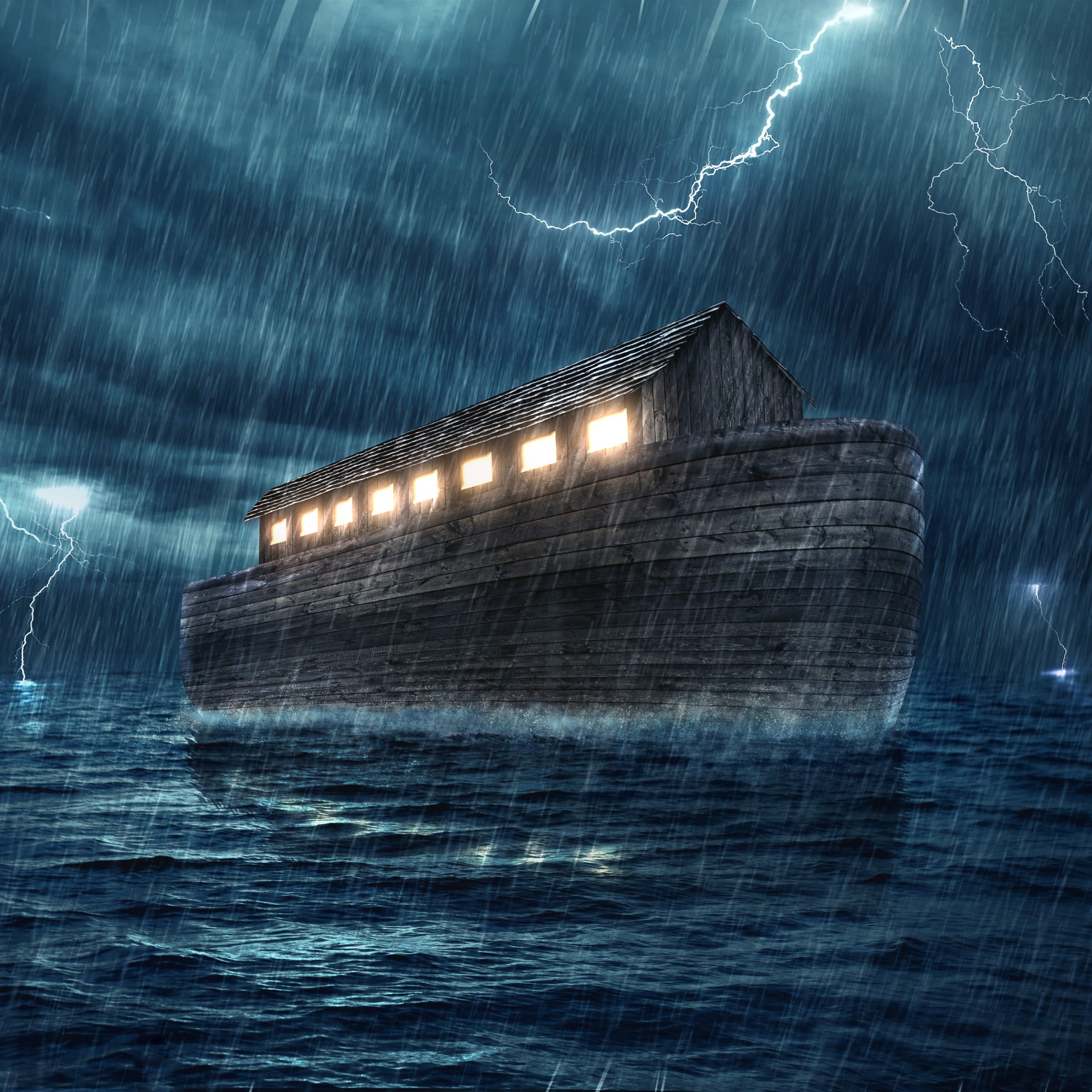
And as we talk about this ark, there's a few words in the Hebrew text that kind of hint us in or clue us in that there is more going on with this ark than what we see.
And one of those words is when he's going to pitch the ark, he says, I want you to pitch the ark with pitch on the inside and on the out.
And the Hebrew word they use for pitch is kephar.
And if that sounds familiar, we talked about it in the beginning with the Garden of Eden, because Kaphar is where we get cover from it's where we get Yom Kippur, Day of Atonement. So he's not saying pitch it. The word pitch isn't there. He's saying cover it or atone for it. Cover it on the inside, cover it on the outside.
And this idea that the vessel has to be clean on the inside and pure as well as on the outside if it's going to save you from. From the impending waters that are coming.
The other one here is when he talks about that thou shalt make a window in the Ark.
And Nate, did.
Did you want to dive into this? I know this was something you should probably.
[00:14:02] Speaker A: You should. You. You do your thing, and I'll jump in as needed, because this. This one has been a. This one is what I've. I have definitely gone down the rabbit hole of this this week. But. But you should. You. You should set it up.
[00:14:13] Speaker B: Okay.
Again, the Hebrew word here for window, it doesn't necessarily mean window. It comes from tsohar, tsohar, coming from the verb tzar and zahar. It's a primitive root. It means to glisten. But the reason why, it means to cliston. It comes from a root that means to press out oil, to make oil.
And so as oil is glistening, they look at that and say, okay, maybe this glistening, this source of light or glistening, and maybe create a window. And it's interesting to see how the different translators took this, because as it was translated from the Hebrew to the Greek, there was a translator that looked at it, and instead of translating it as window, they looked at it and said, okay, this comes from making oil. Maybe it's a collection. Let's make a collection in the Ark. So the Septuagint, the Greek refers to it as a collection place, whereas in the Hebrews, kind of this glistening window type deal, and it creates for this uncertainty. But there was a translator, Jonathan Ben Uziel, who was one of Hillel's students, meaning that he was alive at the same time as Christ.
So he was here on the earth same time as Christ.
And he takes this word, and he's not translated as a collection. He's not going to translate it as a window, but he actually translated it as a stone. And he has this idea that this stone Noah had collected from the river Sidon that they took to illuminate the ark while they were in it, which obviously has its interesting ties with the brother of Jared and the story there.
And as we're talking about Jonathan, I wanted to kind of hit something that he said as Far as he was translating it says when he wished to procure a translation of the Kedavim, the writing. So the Old Testament is divided to the Torah, the law, the ketavim, the writings, and the Navi, the prophets. So as he was translating the writings, Kedavim, a divine voice was heard telling him that which he had done was sufficient for humanity.
So he relied heavily on inspiration from the Lord. And he's the one that kind of gives us the source of this idea of a stone being used to light up the ark in there. But it's fascinating that this stone, this idea of light, whether it's a window, whether it's stone, also comes from the same idea of a stone that's being. Or, excuse me, of oil that's being pressed.
So I'll take us this far, Nate, why don't you jump in?
[00:16:58] Speaker A: That's fantastic. I mean, that's really incredible insight. I don't know if I have a lot more to add to that other than I've been listening to. I've started listening to a lot of rabbis, like daily, like Jewish rabbis daily thoughts or podcasts or whatever. And one that I found through, I don't know, some Reddit page suggested Rabbi Lord Jonathan Sacks. Have you ever heard of him before?
[00:17:27] Speaker B: I have not.
[00:17:28] Speaker A: He's awesome British guy and he's been for sure my favorite listen. But he gives us these little 10 minute daily things or even less sometimes. But I actually found one where he was talking about the episode was called the Light of the Ark. And he talked about both of those things and about how.
How both a window and a stone both make sense. And he said, what is the symbolism of each?
And is there a reason that we should learn a lesson from each of those things? Right? The stone. A stone, a luminous stone that can light from within, or a window that can be, you know, that during the middle of the day that the sun can be the light, right?
And he proposed kind of this really beautiful, profound thing, which is this is that there is so much that we can gain from God through science, right? Or looking out, looking into the heavens, looking into nature and that.
And kind of as I was reading this, it made me think a lot of Moses and Abraham and a lot of the other prophets, the visions that when God would show them these visions, he would, he would say, hey, look, look at the stars and look at these, look at these worlds without number that I have created. And why would he show them that? Right?
Other than unless there's a purpose, unless there's a Lesson to be learned from that, right? And this idea that if it was a window, it could at least represent the idea of looking to the stars for light, looking to the sun for light. And as, again, like, I know that he is a, you know, a Jewish rabbi and doesn't see the sun as the same symbol that we do, right? But that even in nature, the one thing in nature that's still giving us light is what?
[00:19:24] Speaker B: Right, the sun.
[00:19:26] Speaker A: The sun.
But that. The. But that there's also when. During the flood when the sun was covered up because of clouds and rain clouds and stuff like that, that there was a light that you could find within you, right? And that this vessel, or the word as it can be translated as to. Or as I like to look at a lot of these things, even us as humans, right? These vessels, these perfect combinations of both nature and science and one side of God's creation plus the breath or the word of God within us, right? The spiritual side of that. We are the combination. We are the marriage of those two. That this luminous stone or the light of. Or the light of God is something that can also guide us and shine light. And the idea is that to know God and to learn God and to understand God, there's things that you can learn from looking outside, and there's so many things that you can learn from within, right?
And. And a lot of.
And again, it just made me think of a lot of even stuff that we've read to this point, right?
This idea between. This idea between science versus religion or.
Or the idea that God is the perfect marriage between, you know, science and spirituality or science and religion, right? And we talked about a little bit on the way over. You know, what is the first.
What was Adam promised that messengers were going to be sent down to Adam from God to give him, what, a.
[00:21:12] Speaker B: Further light and knowledge.
[00:21:13] Speaker A: A further light and knowledge, right? And when we're taught that we read about this all at the time in doctrine and covenants of both wisdom and knowledge, you know, and it's interesting that light and knowledge, if they were the same thing, then it would be redundant that those things were said, right? And. But it's like, oh, well, maybe in this context, oh, Adam was being taught science and religion, right? And. And even Satan, like his snarky, oh, you want religion? Well, I'll give you religion. It's like, well, no, no, no, no, because religion without truth is. Isn't light, right? Religion without religion without light is whatever. I mean, science to some people is religion, where science is truly just a Means of explanation.
And light gives meaning to that science. Right.
When Adam is kicked out of the garden, it's. You've already said it. He had to learn how to till the earth. He had to learn how to work and to live by the sweat of his brow. He needed to learn at least the natural science of, if I want to eat, I need to plant seed, I need to raise something.
But then what was he commanded to do with that?
Offer a sacrifice. Right. And he didn't even really know why at first until the angel came and said, why are you doing this? I don't know. Okay, well, let me explain it to you. And therefore, you have religion adding context and meaning to that science. Right? Again, it's the perfect harmony of the two. I'm going to learn how to do this. I'm going to learn how to tame nature. I'm going to learn how to understand nature, and then I'm going to offer that as a sacrifice that's going to be used in my religious practice. Because there's something to be learned from that on a spiritual level, too.
[00:23:09] Speaker B: And as you're talking about that, I think of if I were to enter a room blindfolded to where I can't see anything in the room, but you were to describe to me what's in that room, and that's not even a fair example.
Maybe it would be even better to say someone who's never seen ever before and try to explain to them what the color blue is or the color green or what something looks like.
And you can describe it, they can have a knowledge of it, they can have a familiarity of it.
[00:23:47] Speaker A: But.
[00:23:47] Speaker B: But when you add the light of being able to see it for yourself, it's almost more profound.
And it's interesting because light is truth. But you're right, they are put side by side, light and knowledge. Almost as if a deeper appreciation maybe, of the truth.
[00:24:07] Speaker A: Or could it also be that sometimes, maybe there are people, and probably sometimes us, that rely too?
Not rely, but are focused solely on one and at complete disregard for the other, right?
To where it's just like, no, I don't need to ever learn about anything other than what's in the scripture that I have in front of me. Okay, well, cool. Well, don't you want to know how that has some sort of, like, context to, like, what you literally need to do to survive when you wake up in the morning? Nope, I only need to read. You know what I mean? Like, I only. Or the flip side of that, which is I only believe in Science, Right. Like, like, okay, well as long as you admit that science then is your religion.
Because science is a mean of just asking questions and trying to discover. Right.
And so not to cut you off, but, but that's, but the thing is, it's like I think that those things are always put side by side clearly for a reason. That is, if you want to actually further understand the universe and if you truly are committed to this idea that we can become gods after this life, you're going to have to understand that science was used in creating this universe on some level. Divine science, sure, you know what I mean? Like the most profound of all sciences. But there are certain laws in the universe that even God works within. Right?
Like things move in certain ways and gravity exists and all these things. It's like, of course that's.
This to me, this to me is a testimony of God and not a removal of the need for God.
Right? Like this is more of just like how great is my God that we're still trying to see the vastness, the limitlessness of his scope, of his reach and his touch. And yet he knows me.
He knows me as an individual, which by the way, dude, I could live and die and the universe will never know I existed.
I will eventually be back into that dirt.
But because, because yes, even though God can create a never ending scope, he still cares about me.
Like, the profoundness of that, I think is the reason that it's important to understand that that's maybe why those two things are put together, is that both of them, you can learn so much about who you are and who God is through learning of science and nature and of committing to, to having a personal one on one relationship with that Creator.
[00:27:02] Speaker B: Well, let me juxtapose this then with the people before the flood who relied only on the science, this idea that they could save themselves despite God as maybe knowledge without light.
But then take some of our founding fathers of science, if you will take Isaac Newton, who believed that studying nature was an acceptable form of worship for God because if he studied God's creation, he gained a deeper appreciation for God himself.
Right? So he's coupling that knowledge not to replace the light, but in combination with the light to have a greater appreciation. Who by the way, wrote more papers, more arguments in scripture and religion than math and science combined.
[00:27:57] Speaker A: And that's, that's, that's a, that's a perfect point. And again, I'm going to let you go, my last thing about that to what you just said is. And again the opposite of is like, yes, we rely on God completely. Yes, great. But what does God tell you to do? What did God tell Adam to do?
[00:28:12] Speaker B: Go work. Go work.
Go learn. Go, go learn.
[00:28:16] Speaker A: You need to literally go learn how this earth that now, instead of just producing all of these great things without you having to do anything, now, instead is going to produce thistles, thorn, and things that are gonna choke out all of your hard work unless you can learn how to tame it.
[00:28:31] Speaker B: And who, by the way, Joseph Smith says, we save ourselves as fast as we gain knowledge, for that's how God saved himself, by knowing more than anything else. He can subject it all below his.
[00:28:41] Speaker A: Feet to wrap this all up and put a bow on it so we can continue.
Yes, there are a lot of people that think that. I mean, Stephen Hawking, you know, whatever. Some of his last things, again, were like, we don't need God to expl the universe. Okay, I'm sorry that you feel that way. I get it. But the thing is that the idea or the thought process again, as listening to some of these podcasts, is what if you could scientifically, for sure, no doubt point to the day that the universe, the moment the universe was created, how would your life change tomorrow?
Mine wouldn't.
Yeah, I'd go to work.
The idea, though, that I have no purpose here, that I'm here by accident, that I'm not trying to actually become better, that there is no explanation for why my life would immensely, immediately change if that was removed.
You may feel like you don't need anything but science.
I would argue that science is only a means of asking questions and trying to explain certain things, but without God, there's no meaning to it. And I personally at least subscribe to the idea that science has changed and evolved and come and gone and moved and shifted and, and been so certain and then been proven wrong.
But there is one constant, and that's a living God.
[00:30:23] Speaker B: And science maybe delves more into the what and the how it's supposed to, and religion, more the why.
[00:30:30] Speaker A: But when you turn. But when you turn. Yes, and when you try to make science the religion, I just. It's a very frustrating prospect for me, and that's why I refuse to do it.
[00:30:42] Speaker B: It is perspective. They're two important lenses. And maybe it's significant to state. I mean, this whole conversation spun off based on a rock, Right.
Potentially a rock in the ark that offered light.
[00:30:55] Speaker A: And really quick to your. To your oil, though press. Because you blew my mind with this. In the car, I was reading some other kind of like some Kind of periphery Hebrew stories about, about the same Zohar, right, being. Being the same stone that Abraham used to wear around his neck, that when people would come and see him, they would, they would look upon the Zohar and be healed and that and that again and again like that. This stone was something that if you, if you were to.
If the world were to see it, it would outshine the sun. And so that's why God hid it or buried it in the earth and hid it so that only a certain people would be able to uncover it and use it for light.
And I love the connection that you made when you said, oh, it's also is a pressed oil or something like that. I'm like, oh, that even changes the context of that story. It's like, oh, this thing that Abraham had that for healing. For healing so that when people would come to him, he could use that for a healing purpose. And by the way, we have talked about other stones that other prophets have found buried in the ground that have shown all things.
[00:32:20] Speaker B: And that's just where I was going with that. The idea of Urim and Thummim not being a singular stone, but Urim and Thummim, lights and perfections. This idea that you have two stones, two lenses, two perspectives. As we've been kind of venturing down that road with science, religion, light, knowledge and whatnot.
[00:32:38] Speaker A: Awesome.
We're probably going to talk about how these relate to maybe Brother of Jared boats further on. Or is this the time?
[00:32:46] Speaker B: Now's a great time.
[00:32:48] Speaker A: The only connection I just wanted to make to this real quick is again, like we talk about how these arks or these boats kind of have a relationship to us and maybe our bodies, right. This idea that. And even like the Ark of the Covenant. And you've talked a lot about this before about these, these things that carry within it. Now we know Covenants, okay, These, these vessels that we have, by the way, that at least with the, the, the Brother of Jared, their boats, you know, had the hole in the top and the bottom. So that scientifically like you brought up too, you know, you fill, you. You get the air pressure correct in these by letting air in so that you can pull the bottom off and scoop out all of the various waste that's probably happening inside these boats. Right? But what's lighting these boats from both the inside. And there is something that, yes, I'm sure on calm days everybody was probably thrilled to get a little bit of the natural warming light that is the sun by maybe taking that top off. And just like, hey, this is great, right? But then on days when it was. When it was being tossed around or being submerged, that they would still be able to have the light with inside the boat as well. And again, how this relates to this idea of, you know, us as beings, one cleansing the inner vessel, and then the construction of these being those things. And again, just outside light, which is, by the way, amazing. And there's nothing better than being out in the warm sun and enjoying this beautiful natural source of heat and light and energy that God has created. But that there are dark days that we all have that sometimes it's hard to see that and it's hard to feel that. And what do we have given to us other than the light of Christ? And then what we do to either magnify that light and grow that light within us for those dark days.
All right, that's all I got on that.
[00:34:39] Speaker B: And I'm glad you mentioned the brother Jared, because he's not very long after this time period.
And it's interesting, the approach that Nimrod and Babel. He's building this tower because if God's going to send waters to the earth again and flood this out, we're going to be high enough that we can survive this another time. Right. This idea of trying to bypass God.
[00:35:01] Speaker A: You should highlight what you just said, because that's a very profound thing.
Continue with the thought. But, like, that's. I'm just saying, don't just skim past that, because the Tower of Babel, I think, has a lot of really incredible, profound metaphor and symbolisms. And so the one that you're talking about is you're suggesting one of the reasons this tower was being built was.
[00:35:23] Speaker B: To avoid destruction a second time, to prove God, that we're going to make gods unto ourselves.
[00:35:30] Speaker A: Because I don't think everybody has thought. I had never thought about that until you brought it up, because I was always just like, oh, this was just a tower. I mean, we're kind of taught, oh, this is a tower for people to climb because they think they're gonna get to heaven. And the more you actually read the story, I don't think it's. I mean, that's part of it. But what you just explained was like, oh, no, we don't want to become more righteous so that we don't get flooded out again.
[00:35:51] Speaker B: How do we find a shortcut? It goes all back to the same deal. Like what?
[00:35:56] Speaker A: By the way, to spite God or to tempt God or to provoke God.
[00:36:01] Speaker B: Again.
[00:36:02] Speaker A: Again.
[00:36:04] Speaker B: Again.
[00:36:06] Speaker A: Sure. Send the waters again.
[00:36:08] Speaker B: We've already built this tower and who gets the waters? It's not Nimrod, it's not Babel. Jared gets sent back into the storm.
Ironic enough, Jared is the one that has to deal with the flood. And you know what?
[00:36:21] Speaker A: It doesn't faze. Harden him up.
[00:36:23] Speaker B: It doesn't faze him.
[00:36:23] Speaker A: Nope.
[00:36:24] Speaker B: Harden him up because he brings his light with him and he trusts in the Lord. It doesn't matter if the storm comes or not.
You don't have to lean on your own riches, you don't have to lean on your own learning. Lean on God and he'll get you through it.
[00:36:39] Speaker A: Yep.
[00:36:40] Speaker B: And the Hebrew word for heaven is shamayim. Mayim means water. Shah means there is, Shamayim is there is waters. And if you're going to pass through the heavens to get to where God resides, you pass through waters.
And this idea that Noah is passing through these waters, he's taking his journey to paradise, to heaven, back to Eden. This restoration, this atonement idea one more time.
And you see it with Enoch and you see it with Lehi, and you'll see it with us because as Joseph Smith says, he's born to tread deep. Water trouble, problems, afflictions, whatever the case may be, the waters of baptism being symbolic of this, we're going to pass through these moments that we're going to feel like we're drowning.
But that's part of it. That's part of what it takes to get to the other side.
And by the way, that's why they call it the Ark of the covenant is if God is coming to here and he's passing through these waters and meeting us, they have this ark that he sits on. Go look at the facsillomy of Abraham and the pearl of great price. And look in the upper right hand corner and see the boat with someone sitting in it. And look at the description. It says God sitting on his throne, which is a boat.
And these Babylonians on their Akitu festival and they would have a miniature boat that God would sit on in the temple and they would take him out of the miniature boat into a full sized boat and transport him through the city on the boat. And some of these pagan temples would have tie up posts on the roof of them for these boats to anchor themselves to because there is water that you have to pass through to get where God resides today. It's kind of this interesting concept going back to Noah and these waters and passing through these waters. And again, the ark is like a womb and in a womb, you're surrounded with waters and you're delivered out of the waters. And so he's being born again, the earth is being baptized.
And this idea that we all need to be born again to get to that heaven, we go through something similar to Noah.
[00:38:53] Speaker A: Powerful imagery, great imagery. I love this stuff.
[00:38:56] Speaker B: And the ark itself. Did I mention Noah, according to one of these books, as they're talking about how he's building the ark, he takes this platform of wood and a wooden mallet and he strikes it three times.
It's kind of this interesting imagery. And the ark itself is built three levels.
And you can kind of look at that and compare it to this idea in the temple as you're going through the three different levels, the terrestrial, terrestrial, as the lighting and the atmosphere changes, this idea that this ark embodies it. And I just wanted to read. This is again from the Book of the Cave of Treasures, this description of life inside the ark, if you will.
[00:39:35] Speaker A: And it gets, by the way, and it gets more light the closer you get to the top.
[00:39:38] Speaker B: Yes, absolutely.
[00:39:39] Speaker A: Where either that window or that luminous rock is being hung. Okay, so I keep going.
[00:39:44] Speaker B: Hearken thou, Noah, thou blessed of the Lord. Behold, I am going forth from this world like all my fathers. But thou and thy children shall be saved, and thou shalt do everything which I am commanding you to do. This day, God will make the flood. When I die, embalm my body and bury me in the cave of treasures with my fathers. Take thy wife and thy sons and the wives of thy sons, and get down out of this holy mountain and take with thee the body of our father Adam, and these three offerings, gold and myrrh and frankincense. Set the body of Adam in the middle of the ark and lay these offerings upon him.
Thou and thy son shall occupy the eastern part of the ark. Thy wife and thy sons, wives shall occupy the western part thereof. Thy wives shall not pass over to you, and you shall not pass over to them. Ye shall neither eat nor drink with them, and you shall have no intercourse whatsoever with them until ye go forth from the ark.
And I can't. I just. Fascinating to me to think of this, this aisle and the men sitting on one side of the ark, the women sitting on the other side. And, oh, by the way, at the head of them sits the body of Adam, which is symbolic here of the body of Christ with the gold, the frankincense, the myrrh in this. If you think of this as a coffin or an altar, that's Going to come and atone for Adam.
This imagery again, that here within this ark, you have this idea of a temple like setting where you can find sanctuary, where you can be atoned and find this restoration that will get you through the waters and deliver you back to paradise.
[00:41:27] Speaker A: I mean, that's unbelievable. And again, like, I always. I do love that you. I love that you brought up, again, just. Again, the idea of the altar or, like a casket or a body, you know, to be sacrificed on the altar. I just. That's. I just don't want to skirt past that either. That's great imagery.
Yeah, that's fantastic. Anything else about the ark you want to go over?
I mean, that's pretty good stuff, man.
[00:41:51] Speaker B: There's some crazy stories. Maybe I just glance over, but I won't read anything.
[00:41:54] Speaker A: Dude, we're running out of time. I mean, unless we got to get the crazy stories in this.
Do we need. Because we haven't. We haven't even done Tower of Babel yet.
[00:42:01] Speaker B: There's all sorts of fun things in there. Guys, if you want to read about the Tower of. Excuse me. The Noah's Ark, hit us up, and I can send you all sorts of references and crazy.
[00:42:09] Speaker A: Jason told me some of the great stories before, and I. I mean, they're fun, but they're.
[00:42:13] Speaker B: But they're not powerful.
[00:42:14] Speaker A: They're not power. I mean, so, I mean, we haven't even gotten to the tower. Is it Babel or Babel? What do you call it?
Babel.
[00:42:20] Speaker B: I don't know.
[00:42:20] Speaker A: Both. Because, I mean, it works, right?
[00:42:22] Speaker B: Babel.
[00:42:23] Speaker A: Anyways, Tower of Babel. We haven't even gotten into that yet, and there's really great stuff in there.
[00:42:29] Speaker B: Yeah. So let's move forward.
[00:42:30] Speaker A: Okay.
[00:42:31] Speaker B: I want to get to the story of Noah after he leaves the ark.
[00:42:38] Speaker A: And should we do this before or after the Tower of Babel?
[00:42:41] Speaker B: Before.
[00:42:42] Speaker A: Okay.
[00:42:43] Speaker B: This, to me, is the highlight.
[00:42:44] Speaker A: Okay, well, then let's do this.
[00:42:45] Speaker B: This is the greatest part. And. And I don't know why it's the greatest part, because it's actually.
[00:42:50] Speaker A: No, I think it's. From what you've told me, I think that it's a really good, interesting, and probably helpful thing for a lot of people like me, that before this, I didn't really understand why on earth this story kind of has been understood the way it is.
[00:43:05] Speaker B: This is one of the most confusing stories of the scriptures. I get asked about this all the time, and I don't know that I had a great answer. But as I've studied this and Looked at this and not finding an answer outside of the Bible, ironically enough, it was the Bible itself that answered the question for me. Inside the Bible, I was able to find exactly what was going on. The story I'm talking about is Noah. After he leaves the Ar, plants a vineyard, he grows the fruit of the vine, gets drunk, and then Ham discovers his nakedness and he goes out and tells his brothers, and his brothers go in and not just go in regular, they take a garment, they walk backwards, they cover their father's nakedness. And then Noah wakes up and immediately knows what happened, by the way, and curses Canaan, not Ham. But Canaan. And Canaan is not Ham's firstborn son, nor is he his second born or thirdborn. He's his fourth born son.
So I think the question here is, what did Canaan have to do with any of this? Why did he get cursed for what Ham did? And what does this story mean? Why is this even included? There is so much that didn't get included in the Bible. Why is this part of the Scriptures?
So let's dive down this.
There is rabbinical tradition and maybe it's just good to read some of these verses so you can see exactly what some of the issue is when they're talking about Noah waking up.
Verse 24. This is Genesis, chapter nine. And Noah awoke from his wine and knew what his younger son had done unto him.
So there's a couple different interpretations. First, there's the interpretation that just as the scriptures say here, it's more of a voyeuristic thing, Ham sees his dad and because he's spying on his dad naked, it's not good.
Right? The problem with the voyeuristic translation is going to the verse that I just read.
How in the world does Noah awake from his wine and know what his younger son had done unto him?
You don't know if somebody came and looked at you while you were sleeping, it's true.
And he says, done unto him. So Ham had done something to him.
Right.
So the foyeristic doesn't hold water.
There is no tradition or custom in all of the scripture that warrant your fourth son being cursed for spying on your parents.
That's just too weird.
So the rabbi is trying to explain this and I think they take too weird in another direction, but it does fit in some senses. Because it says what their son had done to him, what Ham had done unto him. They look at it as castration.
They say that Ham went in, castrated Noah as a kind of a power play.
And because Noah had three sons, but couldn't have a fourth.
Noah curses Ham's fourth son so that he could have his three sons, but not.
But the fourth wasn't going to be prosperous.
That's what the rabbis say. It does answer the question of why Noah would have known immediately waking up that something had been done to him. And it does answer the question of why Canaan gets cursed, although not very well.
So I don't buy it. I don't like it. I think it's a stretch.
So as I was trying to better understand this, I turned into Leviticus, and I found some very interesting verses.
So let me read to you Leviticus.
Okay, Leviticus 18.
And we're going to go to verse 19 and 20. And hopefully this makes a little bit more sense.
Also, Thou shalt not approach unto a woman to uncover her nakedness, as long as she have put apart for her uncleanness.
And then verse 20.
Moreover, thou shalt not lie carnally with thy neighbor's wife. So you understand what's going on here. You shall not approach a woman during that time of month that she's out for uncleanliness.
Neither shall you lie with. And so you get this idea that uncovering the nakedness is a polite way or a euphemism for saying lie carnally with. You shall not lie carnally with a woman.
And if you go to Leviticus 18 and just read that chapter, you'll see it over and over and over again, this idea that to uncover your nakedness. What's the purpose of taking someone's clothes off, discovering their nakedness, stripping them down, if it's not intimacy? Okay, so going back to the story, this is. This is.
Some people interpret this, that Ham molested his father. I don't think so. But. But it is a. It is a euphemism for an act. Again, because Noah says when he woke up, he realized what had been done. It's not just a simple viewing, but as we. As we go to verse.
Let's see chapter 20, Verse 20 and 21.
And if a man shall lie with his uncle's wife, he hath uncovered his uncle's nakedness.
[00:49:06] Speaker A: Whoa.
[00:49:07] Speaker B: And if a man shall lie with his brother's wife, it is an unclean thing.
He hath uncovered his brother's nakedness.
[00:49:17] Speaker A: Whoa.
[00:49:18] Speaker B: So go back to Leviticus 18, verse 8.
The nakedness of thy father's wife shalt thou not uncover. It is thy father's nakedness.
[00:49:32] Speaker A: Okay, now let's read the original scripture again.
[00:49:34] Speaker B: So if you go back, Ham uncovering his father's nakedness is lying with his father's wife.
Just as it says in Leviticus 18.
If you uncover your father's wife's nakedness, then that is your father's nakedness.
[00:49:53] Speaker A: Or if you lay with your father's, or if you lay with the father's wife, it's uncovering their yes, if you.
[00:49:59] Speaker B: Lay with your father's wife, it is uncovering your father's nakedness. So when he says he discovers his father's nakedness, he's laying with his father's wife.
And there's a reason for that. If you go back again to the original account here with Noah, Genesis, chapter nine.
Scrolling back out of Leviticus.
I say scrolling, but I'm flipping pages. I'm old fashioned that way.
[00:50:25] Speaker A: The analog version, not the digital version.
[00:50:28] Speaker B: Yeah, verse 24. And Noah woke from his wine and knew what his younger son had done unto him. It's key. Ham is the younger son.
He does not have the birthright. He does not get the priesthood.
The patriarchal order is going to Shem unless he can usurp it.
So what happened when Saul was king and David, from a different line takes that kingship?
The Lord gives Saul's wives to David and David now has Saul's wives.
And that's what you do if you want to be king. You marry the queen.
Okay. And you look at Solomon.
When he becomes king, his brother, who had aspirations to get on the throne, sent a request to Bathsheba, we'll get to this when we talk about that. But he says to Bathsheba, can you talk to your son Solomon and ask him if I can have one of dad's wives?
I just want the last wife he had. I kind of have a thing for her. Maybe you can talk him into it. So she goes to Solomon and asks if Solomon will give him the last wife David had. And he executes his brother for it. Why? Because it's a play on the throne.
It's this idea, Absalom.
When he raises a coup and David has to flee as an exile out of the country, Absalom, the son of David, becomes king. He sets up a tent on the roof of the building and puts David's wife into it and goes into the tent in front of all of Israel so that they can see he is the king. What Ham is doing here is a power play.
He wants the priesthood. He wants the line, the birthright. And to get it, he is willing to steal it by sleeping with his mom.
That's what's going on here.
And the cool thing I think about this is the way the writer handles the situation. You look at Shem and Japheth who take a garment, and what are they doing with the garment? They're going to cover their father's nakedness.
And the word cover, as we've talked about, they're going to atone. They're trying to try to hide it, right?
And not only are they not going to just hide it, but they're turning their faces the other direction to not even look, let alone participate.
So as they walk backwards to cover it, to try to hide it, I think that's what the author is doing here. Rather than make this the scandalous account and bring shame upon Noah's wife, the author is covering what happened by making it seem like a voyeuristic account, like he saw his father's nakedness. Noah's wife isn't even mentioned anywhere in here.
It's like he's looking the other way and doing the best he can to try to cover it. But this is an important part of the Bible, because Ham making this claim, which, by the way, is why he would go out and tell his brothers, why would you do that? Why would you say, hey, guess what I did? Or guess what I saw? Unless you're not trying to assert your dominance and saying, I did it. This is now my line. So that means that Canaan, the fourth son, is a product of Ham and this illegitimate affair.
That's why.
Now note, and you read it in the book of Moses, Noah curses Canaan to the priesthood. Because now Canaan is trying to claim, legitimate claim, that through Ham's usurping this, through this affair, he is now the legitimate line. And so Noah has to curse him to the priesthood to set the record straight and say, no, Shem is the birthright. You're not getting in line and cutting in front. And again, this idea of Satan trying to talk him into taking this shortcut or getting in there, become like God, do what you can to cut in line and put yourself first.
[00:54:41] Speaker A: No matter what it takes.
[00:54:42] Speaker B: No matter what it takes or how.
[00:54:43] Speaker A: Evil it is, what you're actually doing.
[00:54:45] Speaker B: And the cool thing about the story is the way it's presented in the Bible. One, again, like I said, a lot of respect for the writer to treat the situation like he did.
We're not making the scandalous. We're not making a big deal out of it. We're not embarrassing innocent parties. We're going to cover them as much as possible. But you have a chiasmus maybe. We've talked about chiasmus.
[00:55:07] Speaker A: We did a lot in Doctrine and Covenants.
[00:55:09] Speaker B: Yeah. For those who are new to this. And a chiasmus, you're. You're saying an event, and the next one, and the next one, and then you're reversing the events in backwards order again, getting back to where you started.
So the first shall be last, then the last shall be first. So the last goes together in the middle and the first goes together on the outside. Bookends in this case, what started off that made God so angry with the children of men was that the sons of God went in unto the daughters of men.
That's what started this chiasmus. And it's going to take the ark, this imagery of atonement, as we've talked about, and put this at the center of the story and finish it with. And right after what happens now you have a son of man, someone who's fallen or doing something, going to a daughter of God, almost kind of reversing the roles and again creating this.
This line of.
What do you want to call it? Distaste or disrespect or reintroducing this evil back into the world.
So it's kind of interesting how it's put into the story that way.
[00:56:23] Speaker A: Great stuff.
[00:56:24] Speaker B: But the reason why it's so important, this is context here. Canaan is the father of the Canaanites.
As we read the whole Bible and you see Israel constantly at odds with Canaan, it stems back to this. Israel is descended from Shem.
Canaan is descended from Ham. They have this claim, who has the authority? Who is the right line?
Canaan usurped it.
And Shem is saying, no, Noah cursed you to that. This. The reason why the writer had to include it at the risk of embarrassing innocent parties, was to give you context for this feud that is going to spill out over the rest of the Bible between Israel and Canaan. And by the way, Ham's other son, Mitsrayim, the Hebrew word for Egypt is Mitsrayim. If you were to translate that Hebrew into English, Ham's son's name is Egypt.
So you look at Ham's sons, Cush begets Nimrod, who creates Babel, which is going to be turning into your Babylon. And he creates Egypt and he creates Canaan.
And the dealings for the rest of the book is Israel and their relationship with Babylon, with Canaan and with Egypt.
This is context. This is setting the stage. This is giving us the background to that relationship that we're going to Be following through the rest of the year.
[00:57:57] Speaker A: Bravo.
Nice, Nice. Nicely done.
[00:58:01] Speaker B: And then we have the Tower of Babel.
[00:58:03] Speaker A: That's great.
Tower of Babel.
[00:58:07] Speaker B: Tower of Babel.
[00:58:07] Speaker A: I have some thoughts on this one too, but I want you to set this up.
[00:58:11] Speaker B: Okay. There's a few things. Let's go into Genesis.
There's not a ton in Genesis. There is one word. I want to kind of hone in on this.
Sorry, flipping my analog scriptures.
Okay.
We talk about the Tower of Babel, chapter 11. And the whole earth was of one language and of one speech. And by the way, sorry, going into chapter 10, with all of the begatting.
[00:58:42] Speaker A: What?
[00:58:44] Speaker B: We skipped over a lot of begatting in this lesson.
[00:58:48] Speaker A: Do we need to go back? Do we need Begats part two?
[00:58:52] Speaker B: Maybe two.
[00:58:53] Speaker A: No, you don't. Okay. I'm just saying.
[00:58:54] Speaker B: I mean, we could make this as many as the Rocky series if we needed to. There's a lot of Begats in the Bible.
Okay, going verse 25. And unto Eber was born two sons, the name of one, Peleg. For in his days the earth was divided. Was divided.
[00:59:08] Speaker A: Peleg with a G. Oh, not the soccer player.
[00:59:11] Speaker B: And his brother's name was Jokdan.
This thought of the Earth being divided, I know a lot of people think Pangea and the continents separating, maybe that's the case. But what I find interesting is if you look at these begattings and these genealogies, Peleg corresponds with Nimrod and the Tower of Babel. I tend to think in the days of Peleg, the earth was divided in the sense that all of the people, like in verse going back, and this is what kind of touched me off on this. Chapter 11, verse 1. And the whole earth was of one language and of one speech. The earth was unified as one people, one language, one speech. But with the Tower of Babel, this sets off an event that's going to fracture the world and separate them into different cultures, different languages, different people. And the earth was divided. That's how I interpret it.
[01:00:00] Speaker A: Okay.
[01:00:01] Speaker B: All right, moving to verse two. And it came to pass that as they journeyed from the east, that they found a plain in the land of Shinar, and they dwelt there.
And verse three. And they said, one to another, go, let us make brick and burn them thoroughly. And they had the brick for the stone and the slime for the mortar. And then. And they said, go to, let us build us a city and a tower whose top may reach unto heaven.
And again, you see that italicized.
You could read it. Whose top unto heaven.
And they put that may reach to kind of help you understand the language differences.
[01:00:40] Speaker A: Okay.
[01:00:41] Speaker B: And let us make us a name, lest we be scattered abroad upon the face of the whole Earth. They almost knew what was coming. Like there was a warning. If you do this, God is going to scatter you. Really?
[01:00:55] Speaker A: Let's do it anyway.
[01:00:56] Speaker B: Let's find out.
[01:00:57] Speaker A: Let's find a way around this, though.
[01:00:59] Speaker B: Going back to the beginning with Noah, God says, I'm going to send a famine. Really?
[01:01:03] Speaker A: All right, well, let's see how we provoke you. We're going to show you why that doesn't matter. We're still going to make it work.
[01:01:07] Speaker B: Let's find our way around a famine. Let's find a way. But because they say, let us go by a name, I've heard people take this word, this one verse, and make a compelling argument that the Tower of Babel isn't as much a tower as much as it is a temple. That they're going here to get a name and to storm the gates ahead to find a way to subvert the ways of the Lord, to get their own entrance into their own version, their own.
[01:01:36] Speaker A: I'm glad that you used that word, because when I bring up my thoughts on this, I'm going to use that. Exactly what you just said. And I didn't even know you were going to say that, but you just made me feel even more secure in some of my thoughts. Keep going.
[01:01:47] Speaker B: Oh, good. So that's one take on it.
As we mentioned a little bit earlier, this idea about trying to reach into heaven and find your alternative route. I mean, this is.
This is what Genesis is all about. If you haven't picked up on that yet.
[01:02:06] Speaker A: Satan's way versus God way.
[01:02:07] Speaker B: Satan's way versus God's way. And let's build a way. If God sends the floods, we've got a tower now. We can get above the floods. Do what you want. Do your worst. We're prepared now, right? What are you going to do now? But it's kind of a cool story.
They said that there was several different groups of people that had different purposes in mind. And one third of these people had this idea that they were going to build this tower to get into heaven and storm the heavens and kill God and sit on his throne.
[01:02:42] Speaker A: Whoa, wait, you mean a third of the people?
[01:02:46] Speaker B: A third of the people. Interesting enough.
[01:02:48] Speaker A: That seems interesting.
[01:02:49] Speaker B: And as they got to the top of this tower, they started shooting arrows into the clouds.
And it says that the gods and the host of heaven would take the arrows, dip them in blood, and then send them back so it looked like they were hitting something. And they are like, wow, look, we are getting.
[01:03:05] Speaker A: It's working, guys.
[01:03:06] Speaker B: It is working.
And then God just smashes the whole thing and says, not anymore. And confounds the language. Kind of a crazy, weird story.
[01:03:15] Speaker A: That is great.
[01:03:16] Speaker B: But I mean all of it. Trying to display this image of.
Of trying to find a different way into heaven, trying to put yourself on the throne of God, trying to take his place. I think that's what the story of the Tower of Babel is all about.
[01:03:35] Speaker A: Okay, cool.
[01:03:36] Speaker B: All right, Nate, hit me.
[01:03:37] Speaker A: Let me just hit you with a couple thoughts because again, very well explained and very thorough.
The things that popped out the most to me with this story were like, we talked about the.
Not just a shortcut, but the.
But again, another example of the false way or the. Or the.
Or the twisted or wrong way of doing something that we're commanded to do. Right, so you already brought this up with even using the word temple.
What was.
Before we had physical temples back at this time, where would people go to commune with God?
[01:04:20] Speaker B: Mountains.
[01:04:21] Speaker A: Mountains, Right.
What does it take to climb up a mountain?
[01:04:25] Speaker B: Effort.
[01:04:26] Speaker A: Yes. And sometimes weapons and sometimes. You know what I mean? Like.
[01:04:31] Speaker B: Yes.
[01:04:33] Speaker A: And there is an effort that it takes to start at the bottom of something and climb up to the top of something. I probably already mentioned this, but that fantastic docum documentary I watched, 14 peaks where it talks about.
Where it talks about, you know, this.
This man from Nepal who. Who climbs just these, you know, the 14 highest mountains basically ever. All these mountains 8,000ft and higher. Right. And watching the. The.
At a certain point on those high mountains that are that high, what are you even dealing with weather wise at that point?
[01:05:14] Speaker B: Weather. Oxygen deprivation.
[01:05:15] Speaker A: Yes.
Even the idea that is the closer you become, the closer you get to God, the more physically, the more physically exhausting it is just for our natural body to do. Right.
[01:05:30] Speaker B: The sacrifice, the draining.
[01:05:32] Speaker A: Yes.
And that if you're not prepared, if you're not prepared to do that, what happens to you? You die.
If you are not prepared, if you are, the potential downside of not being prepared to climb that mountain to be in the presence of God is quite literally death.
Right.
Who built mountains?
God did.
We didn't build those. Right. Right.
Now you tell me what sounds like an easier thing to do.
Prepare yourself, train, learn, be ready and climb up God's mountain in God's way and in God's time. And how God wants you to do that which is going to take an extreme amount of effort or as a community construct something that, yeah, might take effort to construct it, but for what purpose?
So that you can take your man made, your shortcut, your cheap, your cheap bastardized version of what God built and the majesty that God built. And here's your cheap version to take the shortcut.
That's your. I look at this as, once again, it's like, oh, okay, cool.
Well, we need to go high up in the air to meet God. Well, I don't want to have to do that hard thing. So here we're just going to construct this and then any of us can go up at any time.
And you look at this again as a temple even, right?
Like, yes, maybe we're not physically climbing mountains, but I don't know about you, but I would say it takes a tremendous amount of effort and commitment and personal sacrifice and commitment and effort to worthily go to God's mountains here, right? Or those temples here that by the way, are constructed in God's. In God's way, right? To his. To his requirements, to his standards, right?
It's. We don't use just cheap materials.
We don't. We don't do this the easy, cheap way. No. Those puppies are expensive and it takes sacrifice from the members of this church to build those. Right?
[01:07:55] Speaker B: Well, in the beginning when they're crushing all their china to put into the temple and make it glisten going back to your delight.
[01:08:03] Speaker A: Yep.
[01:08:05] Speaker B: And it's interesting.
God commands us to build temples and Satan's telling him here, build a temple.
[01:08:14] Speaker A: That's exactly my point.
[01:08:15] Speaker B: It's the same thing that's done everywhere else.
[01:08:17] Speaker A: That's exactly my point.
Is that who it's always, again, it's sometimes the finest of fine lines between this being a righteous offering and being a wicked offering or an unacceptable offering. And sometimes it's the finest of fine lines. And it will always.
The way that you can always know is who's commanding you to do it.
What's the motivation for doing what you're doing, Right?
Is it you following God's way, which is the harder way, at least up front, Right.
It is the way that requires more. And I look at the story of the Tower of Babel and I just go, this is just another flawless illustration of man's attempt to circumvent God's way in a way that they might feel is the easier, more convenient and again, even almost a. Well, what you said that we needed to become closer to you if we wanted to be, you know, if we wanted to commune with God. So look, we built this. We built this tower to do it.
That's not what I told you to do. Well, that's what we did. But you told us to be close to you, so. Satan. Oh, look, you're supposed to climb up high into the sky.
[01:09:32] Speaker B: You're supposed to.
[01:09:32] Speaker A: Yes, but.
Right, yeah. So anyways, that's my only thoughts on it.
[01:09:38] Speaker B: And there's a good argument that Babel itself, bab means gate and el means God. And in the construct like that, the Tower of Babel, it is the gate of God.
That's what they were attempting to do.
[01:09:54] Speaker A: Or at least that that's what they told themselves. It was like. They call. It's like those things that name themselves something, even though you're just like. Just because you named yourself, that doesn't mean anything. Like the Democratic Republic or whatever of China. You're like, no, you're not.
Just because you call yourself that, that doesn't mean, you know, it's like, oh, hey, this Tower of Babel is the gate to God. It's like, oh, I get that you're trying to make yourself feel better by naming it that.
You know, you're trying to justify your cheap. Your shortcut or your cheap version by naming it that. But that's another great, fantastic point. Anyways, anything else about Tower of Babel you want to go over?
[01:10:32] Speaker B: I guess last. Just, you know, it's interesting, the mob mentality. It's almost the group, let's link arms and storm heavens together. It is not the individual that does that.
[01:10:41] Speaker A: He cannot kick all of us out.
[01:10:43] Speaker B: It is the fear that I am not good enough by myself. But if I do this, the idea that Satan said, I will not let anyone fail. Let's save everyone. Despite what you did or didn't do.
Who cares? Let's get rid of accountability.
Let's get rid of what happened or what didn't happen. Let's just find a shortcut, another way in that doesn't require you to do what the Lord actually wants you to do.
[01:11:08] Speaker A: There it is. Good, Good prep this week. Is there anything else you wanted to go over or are we wrapping it up?
[01:11:14] Speaker B: Hey, you know, I don't know if we've said this before, and maybe we did, when we talk about Noah and this imagery of this, this resetting the. The Garden of Eden, the Adam story, recreation. I find it fascinating that just like Adam, he's got his three children, 1/3 is.
Is going the other way and claiming their own authority, where two thirds become righteous. Then you look at the blessing that Noah gives to Ham. Or, excuse me, well, to Ham, Shem, and Japheth. But he says that his tents shall be counted with Shem's tents. And when you give the firstborn, the firstborn receives a double portion for their inheritance. Everyone receives a single one, but the firstborn. And the idea behind this was if you've got sisters that don't get married or you've got to take care of the family, the firstborn gets an extra portion to take care of the rest of the family.
And in Shem inheriting Japheth, that's counted among his numbers, he's receiving a double portion, which, like Christ receiving a double portion, two thirds being double that of one third. And you have the story of God once again being displayed right here on Earth with his prophets.
[01:12:34] Speaker A: Wow. Just another power power insight there to wrap this up. I've loved this episode. Good work, Jason.
[01:12:40] Speaker B: It's been fun.
[01:12:41] Speaker A: Okay, what are we talking about next week?
[01:12:43] Speaker B: I don't know. I was so. I was so hooked on Noah.
[01:12:45] Speaker A: All right, well, then we've been. I guess you're gonna have to discover that with us next week, too, as our listeners.
Anything. Anything else? Are we good?
[01:12:53] Speaker B: I think we're good.
[01:12:54] Speaker A: All right, until next week.
[01:12:55] Speaker B: See ya.
[01:12:58] Speaker A: Sam.