[00:00:01] Welcome to the weekly Deep Dive podcast on the Add On Education Network. The podcast where we take a look at the weekly come follow me discussions and try to add a little insight and unique perspective.
[00:00:12] I am your host, Jason Lloyd here in my basement studio. As you may have guessed by the lack of production value here with no intro music without this show's producer, Nate Pyfer My bad, not his.
[00:00:27] As far as availability goes, I had something come up last minute in a brief window of time that I had to to get it done, so I had to take the opportunity. Nate really wanted to be here and unfortunately the timing just didn't work out and we are already putting this podcast out later than what we normally would have done anyway. So my apologies to you guys who were hoping to have this ready sooner than what it is.
[00:00:56] You know how it is and how it gets early summer when school gets out and things start happening in June, it sometimes gets a little bit crazy to keep up with. Thanks for your patience.
[00:01:06] We've got it now. We've got it ready to roll. Hopefully you enjoy this. Nate will be back with me on the next episode we'll have ready for you guys.
[00:01:15] This week we're going to be talking about Ruth and the beginning of Samuel and although it does cover quite a bit of content, a lot of chapters, this is a little bit more manageable for me as we're looking at just two stories rather than the last several weeks where we've been trying to cram dozens of stories into a week's worth of lesson.
[00:01:37] This is going to be a little bit simpler where we can focus on two interesting stories in the Bible and try to glean as much as we can out of this and see what we can learn. So let's start with Ruth and I've got my scriptures here. We're going to be going into Ruth chapter one and just trying to understand some of the context of what's going on here.
[00:01:58] First off, there is a famine in the land.
[00:02:02] And anytime there is a famine in the land, I want you to think that a famine often is associated not just with lack of food physically, but lack of food spiritually. As the Lord says, man does not live on bread alone, but also on the Word of God.
[00:02:21] So usually when there is a famine in the land, it denotes a time when Israel has strayed and they don't have a prophet, they don't have someone speaking for them that they are heeding, that they are listening to. And so there is a dearth of the Word of God.
[00:02:40] You can see this famine is not a typical famine because the Moabites who live next to the Israelites do have bread.
[00:02:51] So Naomi goes to the Moabites with her husband Elkanah.
[00:02:57] I'm sorry, Elkanah is going to be in the story of.
[00:03:00] Elkanah is going to be in the story of Hannah. That's Hannah's husband. Elimelech. Elimelech, my God is king.
[00:03:09] So she's going to go with her husband to the land of the Moabites.
[00:03:13] Why do the Moabites have bread if the Israelites do not?
[00:03:18] And that's interesting because you're going to be seeing the example that Ruth, who is a Moabite outside of the house of Israel here, shines in being able to choose to worship their God and be faithful to their God and come into a land that's going to be less than willing to receive her.
[00:03:38] And the faith and diligence that she shows to a people that.
[00:03:45] That perhaps going through a little bit of a rough time here. So why is it usually when you look at famines, it is a famine throughout all the land. You wouldn't have bread just in the Moabites or your neighbors or the people right next to you. You would have to go a far distance away to get someone to a region that has not been affected by the lack of rainfall or the destruction or whatever the case may be that's causing the famine in that land. The reason why it's available in Moab, right next to Israel, but not available in Israel is because this famine is caused by war.
[00:04:22] Most likely. This is talking about the Midianites. When the Midianites attacked Israel, they would go through and burn and destroy their crops and make it so they couldn't plant things for a while. So it would take a couple years to recover from the destruction of the Midianites.
[00:04:39] And if we're talking about the destruction of the Midianites with Israel, and that's why Israel is allowed to be able to find bread in the lands round about them, but not necessarily in their own land, then we're also putting this story right around the same time as Gideon. Gideon is the judge that God raises up to deliver Israel from the hands of the Midianites. Just to give you some historical context of when this story is happening.
[00:05:06] Alright, the other thing you need to understand about this story is who the Moabites are.
[00:05:11] Remember when Israel was leaving Egypt, they had wandered in the wilderness for 40 years and they were about to establish themselves into the land of Canaan, the land of Israel. That they were going to inherit.
[00:05:24] As they were getting close, the Lord said to them, I will not give you one foot's breadth of the land of Edom coming from Esau, or the land of Moab coming from Lot.
[00:05:37] Those were lands that were off limit. They had conquered those lands previous to that time. That was their land, and Israel was not to touch it, not even one foot's breadth.
[00:05:47] However, Israel had to pass through the land of the Moabites to get to the land that they needed to go to.
[00:05:54] And they didn't have a lot of bread or resources or supplies. So God told them, you can pass through the land, but you can't fight them. You can't take a foot's breath, and you should be able to buy bread for money. You should trade with them for a fair price and buy bread for them. When you need the bread, Israel goes to the king of the Moabites. If you remember, interesting enough, the king of the Moabites was Balak.
[00:06:23] And Balak is the one who looked at Israel and said, no way. You are not coming through my land. I will not let you pass and I will not give you bread, and I don't want you to succeed, and I don't want you to be our neighbors.
[00:06:38] And he's the one that went to Balaam and offered him a price to come and curse Israel so that they couldn't defeat them. And see, they weren't going to go to war with Balak. That whole story with the talking donkey and everything that we talked about earlier this year, completely avoidable because Israel had no interest in conquering Balak or Moab from a direct command from God. They were just going to pass through, buy some bread and be on their way.
[00:07:04] But Balak made a stand and he arrayed himself in an army. He wouldn't let him pass through the land, and he was going to fight them.
[00:07:11] And because they would not let them pass through and because they would not give them bread, there was a prohibition.
[00:07:20] No Moabites were allowed to enter into the land of Israel.
[00:07:24] They had this deal, you can't go marry a Moabite and bring them in because of this long standing, I don't know, rivalry or this affair that started all the way back with Balak when Israel was trying to establish themselves in the land that God had promised them.
[00:07:46] So when Israel has this famine and they are looking for bread, I guess in that time, beggars can't be choosers. Elimelech takes his family into the land of Moab and his sons Machlon and Chilion go to marry people from the Moabites. And if they're marrying Moabites, it is almost as if they have no intention of returning back to Israel.
[00:08:12] They're rejecting their people.
[00:08:15] And you can see that when Machlon and Chilean marry these two women.
[00:08:22] And after the Machlon and Chilion pass away, Naomi says, go back to your land and be with your people, because if you come with me, I don't have any more sons. You can't marry anyone else in my family.
[00:08:36] You've already been married.
[00:08:37] And even if I were to have a son, I can't because my husband is dead. But even if I were to find somebody and marry him and have another child, you would have to wait like, what, 20 years before you can even marry him. Are you really going to be willing to wait that long? And is he going to be willing to marry you at that point, when you are a lot older than him and he is just starting off in his youth looking for a wife? It is not ideal.
[00:09:01] She says, go be with your people and don't follow me anymore.
[00:09:06] And she is pretty harsh about this in trying to convince them to stay. And you almost look at it and say it is not very hospitable.
[00:09:13] But also remember Israel's prohibition on Moabites.
[00:09:17] They don't want them in their land. They are forbidden from bringing them into the land because of that harsh interaction that they had play out earlier on in the history.
[00:09:29] In that case, one of the women does go back, and it says that when she went back, she did not just go back, but she returned to. To her people, her land and her gods.
[00:09:41] So in the story, they're kind of relating this idea that turning into that land is turning into the gods of that land. Coming into Israel is accepting the gods of that land.
[00:09:52] So not only are you seeing this symbolically portrayed through a famine, this idea that there's no word of God in the land, the people have apostatized or gone astray, but. But also the fact that they would turn away from Israel into a foreign land and turn to the gods of that land and rely on the gods of that land to feed them rather than the Lord to take care of them.
[00:10:18] You kind of get this sense that these are not the strongest of character anyways, at least not the males of the family. The females of the family are very strong in character.
[00:10:31] And you see that with Naomi, you see that with Ruth. But Elimelech and his two sons, Machlon and Chilion, you see the opposite, a portrayal of Weakness and the portrayal of turning away from God to turn into another land to the gods of another land seeking for delivery that way.
[00:10:51] Ruth does a lot to redeem her people in this sense. Because the crime of the Moabites was they would not provide Israel with bread at a time when Israel was hungry, when they needed it, not only would they not provide him with bread, but they went to war and wouldn't let him pass through the land.
[00:11:09] In this case, you have Ruth, a Moabite, who is not only allowing them to pass into the land and come into the land in a time when they need refuge, she is providing that refuge, but she is also providing them with bread. So you have got kind of this recreation, this reenactment, a second chance.
[00:11:28] And Ruth is redeeming the sins of the Moabites. And I like that word redeeming, because you will see this later on when Boaz redeems her. So you have her redeeming this family which is kin to Boaz, Boaz family. And then in turn, Boaz is going to redeem her as well. And say very similar to what you saw with the story of Rahab, Rahab redeeming Israel and Israel redeeming her. And there is something beautiful to be said about that.
[00:12:00] When God wants to save people, he does it oftentimes through people. God sends his prepared children to his prepared servants.
[00:12:11] When you look at we just came through a fast Sunday, the idea that in order to save people that are starving, we put ourselves to starving conditions and we go without food and we hunger. And we feel this want to, in a sense, sympathize with those that are wanting and hungering and need food. And as we put ourselves in that position to help them and take the money that we would have spent on food and we donate it to clothe them or to feed them or to give them and provide for their wants, we are redeeming them. But also by doing that, the Lord says, when was I naked? Did you clothe me or hungry? Did you feed me? In as much as you've done it to the least of these, you've done it unto me. We are doing that to them. And he will say, come in. Because you did these things to the stranger, you took care of them. And I hope you guys see that in the Old Testament, as we have been going throughout this year, over and over and over again, this theme of taking care of the stranger, not taking advantage of somebody because you don't know them or you don't think they will ever see you, Again, but especially those people who are the people that desire extra care, extra protection and extra love, taking care that you are providing for the people that need it, that don't have anyone else to rely on anyhow. I diverge. But going back to that idea of the fast Sunday, by putting ourselves in the shoes of the one who is suffering, we can try to redeem them and help them in some small way. And as we redeem them, we are hoping that the Lord in turn will also redeem us for what we are doing. We see that in these stories with Ruth and with Rahab, and that is how salvation works. And Christ says, come, follow me. And what did Christ do? He put himself in the situation of the sinner, taking the sins upon him, crushing him in Gethsemane, and putting himself in a position where he could relate and experience and feel so that he might redeem them and offer them the comfort and the care that they need to find salvation. And there's many ways that the Lord does this, but I love that he uses his people to redeem and to save his people. And you're going to see that with Ruth redeeming Israel and later Boaz redeeming Ruth. So if you want salvation, find a way to offer salvation to help.
[00:14:45] The same measure that you measure out is the same measure that is measured to you. And as we seek to help and to save, we also might hope that we can receive salvation and redemption in our lives as well. It is a powerful lesson, and it is very core to this message in Ruth.
[00:15:04] All right, moving on. Sorry, I don't have Nate here kind of keeping me on tempo, so I am going to do my best to try to keep this thing moving.
[00:15:13] Mahlon and Chileon, we've already discussed this. Their names mean weakly, sickly, or pining, whining.
[00:15:20] They're not terribly strong in their names.
[00:15:24] And they're making this decision to turn their back on Israel, to turn their back on the God of Israel, to come into this distant land and rely on this foreign God to provide for them, in a sense.
[00:15:40] And Ruth is happy to comply. Now they die. And it's interesting because it says that when they come back to the land after they passed away, if I were to scan through my scriptures real quick to find the right verse, in chapter one, verse 22, it reads, so Naomi returned and Ruth the Moabitess, her daughter in law with her, which returned out of the country of Moab. And they came to Bethlehem in the beginning of barley harvest.
[00:16:11] Now, that might not seem like A huge detail to you.
[00:16:15] The barley harvest started right after Passover.
[00:16:20] So at the end of Passover marked the beginning of the barley harvest. And so if she came into Israel at the beginning of the barley harvest, that means that she was outside Israel in the land of Moab during the passover.
[00:16:37] Now this makes it even more interesting. Think about this. Her son, perhaps her firstborn son, married to Ruth, the firstborn son being the one that was going to be spared by the angel of death at the time of Passover, dies as they are outside of the land of Israel. And it doesn't say whether or not they observe Passover.
[00:16:58] But what if the Lord did not pass them over as they had turned away from the Lord? In a sense.
[00:17:05] Now, whether or not that literally is what happened, I can't say. It is reading too much in the text to pass judgment. And I do not want to judge any of them for being righteous or unrighteous.
[00:17:17] But from a literary perspective, as we are reading this story, the stage is getting set where we have a famine. Instead of turning to the Lord, they are turning to a different country. They are turning to different gods to take care of them, leaving Israel. So not only apostatizing in the sense that they have no food and there's famine, but they are also leaving and turning away from Israel.
[00:17:40] They are relying on this outside support. Their name is weakly and sickly. They marry outside of the Israelites to not just anyone, but to a people that are prohibited from coming into the land. So knowing that they can't return back to their land with the people that they are marrying, they are turning away from the Lord and rejecting him.
[00:18:00] Just like, and I want to emphasize this, there's two daughters in law that married these two sons, and they both want to cleave to her. So if I go to verse 12 of chapter one, turn again, my daughters. Go your way. For I am too old to have a husband. If I should say I have hope. If I should have a husband also tonight and should also bear sons, would you tarry for them till they were grown? You can't wait till these little babies grow up and marry them from having husbands. Would you stay for them from having husbands? Nay, my daughters, for it. Grieve with me much for your sakes that the hand of the Lord has gone out against us.
[00:18:43] Note that she says the hand of the Lord has turned against us in many ways it has with the famine and what the Lord's doing, what's going on here? But. But I also wonder if there is A little bit of a guilty conscience here in what they are doing. They feel like the Lord is punishing them for some of the choices that they have made as well, at least from a literary perspective.
[00:19:06] But anyways, coming to the point. And they lifted up their voice and wept again. And Orpah kissed her mother in law, but Ruth clave unto her, and she said, behold, thy sister in law is gone back unto her people and unto her gods.
[00:19:22] Return thou after thy sister in law.
[00:19:26] And Ruth said, entreat me not to leave thee, or to return from following after thee. For whither thou goest, I will go, and where thou lodgest, I will lodge. Thy people shall be my people and thy God, my God.
[00:19:41] So in the story, as we're looking at these two women, the idea that going back is not just turning your back on a country, but turning your back on God. If you go, she says she went, turn back to her people and turn to her gods, their gods.
[00:19:59] Where Ruth is saying, I will go and dwell where you are, and your God will be my God. So you have that play there.
[00:20:07] So they're demonstrating this weakness, this apostasy. And you can look at this story, much like we've talked about in the previous weeks, this idea that it is almost prophetic, that there will reach a point when Israel will go through a famine. They will lose their prophets, they will lose their guidance, and they will stray from the Lord. And the Lord will find a way to bring outsiders in and create Israel. Just like Christ said, I can raise up seed unto Abraham out of these two stones. I can bring seed in from an outside nation, from an. From an unknown, from a nobody. I can bring Israel up again from there.
[00:20:44] And you see that in the prophetic of the last days that Gentiles will be the nursing fathers and the nursing mothers of Israel.
[00:20:51] So you see that aspect of the story with Ruth being brought in from the outside and choosing to follow a God, where these guys are choosing to follow a different God. And I think I've probably harped on that point way too much at this point.
[00:21:08] But again, this idea that not only do they go outside, but they went outside during Passover as well.
[00:21:18] They were not in the land of Israel during Passover.
[00:21:21] And for what it is worth, I mean, they are mentioning the death of these sons during the time of Passover, almost as if it is the angel of death. They were not observing or observant as they should have been, anyhow, going on.
[00:21:39] She cleaves to Naomi, returns and decides to try to make her way in, into Israel. And she's going to be starting on the fringes, just like Rahab, who was sent on the fringes of the camp. She is going to be on the fringes. She's not wealthy. She doesn't have any inheritance. She's not an Israelite. She doesn't have land. She doesn't have a husband. Her husband is.
[00:22:04] Is dead.
[00:22:05] And so even Naomi, she might lay claim to the land that was her husband's land as a widow, but without males to pass it on to, she's going to lose her inheritance.
[00:22:22] She's kind of in a rough spot.
[00:22:25] And so much so that she's actually going to sell her land.
[00:22:29] And to give you some context, the land in Israel in the Old Testament was never land that you possessed. It was God's land that he gave to the different families for an inheritance. So the land that she had, if she had to sell it in her poverty, it would be redeemed on the year of jubilees, so she could sell it so that the amount of food that that land would produce each year would be the price that is that is paid for the land so that she can sell it. And then after the year jubilees, then it's redeemed and it falls back to her without a price.
[00:23:07] And so she has to sell it because she doesn't have any money right now to be able to have somebody else that can work the land and that can turn a profit from the land.
[00:23:16] And they're giving her the money for what the crop would yield to get by. So she's kind of been disinherited.
[00:23:24] That's, I mean, the final example. I mean, yes, she turned away. Yes, she left.
[00:23:29] Her sons died in the Passover, when the Passover was supposed to protect Israelites from the son being killed.
[00:23:35] And she returns, she's poverty stricken and she loses her inheritance because she's not doing well. And Ruth has to go out and glean the fields. And we're going to introduce into the story the narrative here, Boaz.
[00:23:50] I love the way they introduce him. And I feel like we need to address the translation here. So this is chapter two, verse one.
[00:24:00] And Naomi had a kinsman of her husband, a mighty man of wealth.
[00:24:05] So the Hebrew word for mighty man here is givor. And givor is the same as you see as the Givorim, David's heroes, typically the givor. And this is where the word, the name Gabriel comes from. Gabor El, hero of God or champion of God, soldier of God. The typically the givarim the givors, they're the heroes, the soldiers, the mighty men, the fighting men. Okay, so there's the hero of God, a mighty man, a powerful man, and it says of wealth.
[00:24:41] Now the word for wealth, this is something else that's also interesting.
[00:24:46] 88% of the time, the word is not translated as wealth. The word is translated as army, host, soldiers, power, valiance, strength.
[00:25:01] And only about 12% of the time is it translated as possessions or wealth.
[00:25:08] So looking here, if they were to list off all of his possessions, saying he's a man of wealth, he had fields, he had grain, he had this, then context would tell us, okay, we should translate this as wealth. But you look at it, it's not mentioning his possessions, the family of Elimelech, and his name was Boaz.
[00:25:27] It's not telling you about how much Boaz possessed and how well off he was financially.
[00:25:33] But you do have the mighty man, the Gibor. And if you're saying that he's a mighty man of army, of power, of strength, he's a mighty man, there is a good chance, especially when you're looking at the timeline with the Midianites destroying the Israelites crops, that Boaz was a man, a mighty man, a man of renown. Like they said in Genesis in the beginning, the gavors, that he was a war hero.
[00:26:04] Now think what that means. If they are using this to introduce Boaz and his character.
[00:26:11] Think about who war heroes would have been in the time of Gideon.
[00:26:15] Gideon raised his army. Do you think the war heroes were the thousands of Israelites, when given the chance to turn around and go home versus fight, would be the ones that turned around and went home.
[00:26:29] So he said, anyone who is afraid to fight, turn around and leave. And then he says, anyone that lays on their belly to drink by sticking their head in the pond, as opposed to bringing the water up to their face. Instead of being in a position of readiness, alert and always watching you go home as well. You are Talking about only 300 men in all of Israel. From a fighting army of tens of thousands of men. Only 300 are left to fight the war.
[00:26:57] And these 300 men deliver Israel from all of the Midianites and save them. Think of the prestige of these men being righteous, upright, valiant, that these are the clean men that are not worshiping the other gods that the Lord could depend on. Because remember, Gideon also had to. He was a little uncertain about the righteousness of the people.
[00:27:20] When he tests the Lord by putting the fleece out with the water, that test and like, are these people people that are going to be delivered?
[00:27:29] And so the way they introduce Boaz to me, I look at that and I read it, and it seems like they're introducing not just a great man, but the cream of the crop, one of these 300 heroes that delivered Israel. That is what it seems like to me. That is. That's the impression I get when I read this introduction of who he is.
[00:27:53] And his name was Boaz. And it's widely accepted in Hebrew that Boaz is interpreted as in him is strength. Now take that again. Compare it with her first husband, Ruth, whose name was Weakly or the lack of strength. She went from a lack of strength to a source of strength.
[00:28:15] She went from a Moabite God. Remember, again, the husband wife relationship is very significant throughout the Bible to describe the relationship that we should be having with God, that He is our husband and that he gives his life for us and we give our life to him and we love him in this pure relationship. She went from a relationship of weakness and worshiping a God that wasn't God to a relationship in strength by worshiping the Israelite God.
[00:28:48] And she had to forsake her wealth, her bread. She was doing well in the land of Moab and gave it all up to come into the land of Israel, where she is now poor. She's gleaning the fields, but she gives it all up to serve the Lord. And she's going to find that loses their life in the service of God will find their life, or she that loses her life, in this case will find life.
[00:29:14] So there's some interesting play that's going on in the story that you kind of miss not understanding the names or the history or where they're coming from. And I'm sure Nate at this point would be kind of brushing me along the way, trying to get me to go a little faster. So let's keep going.
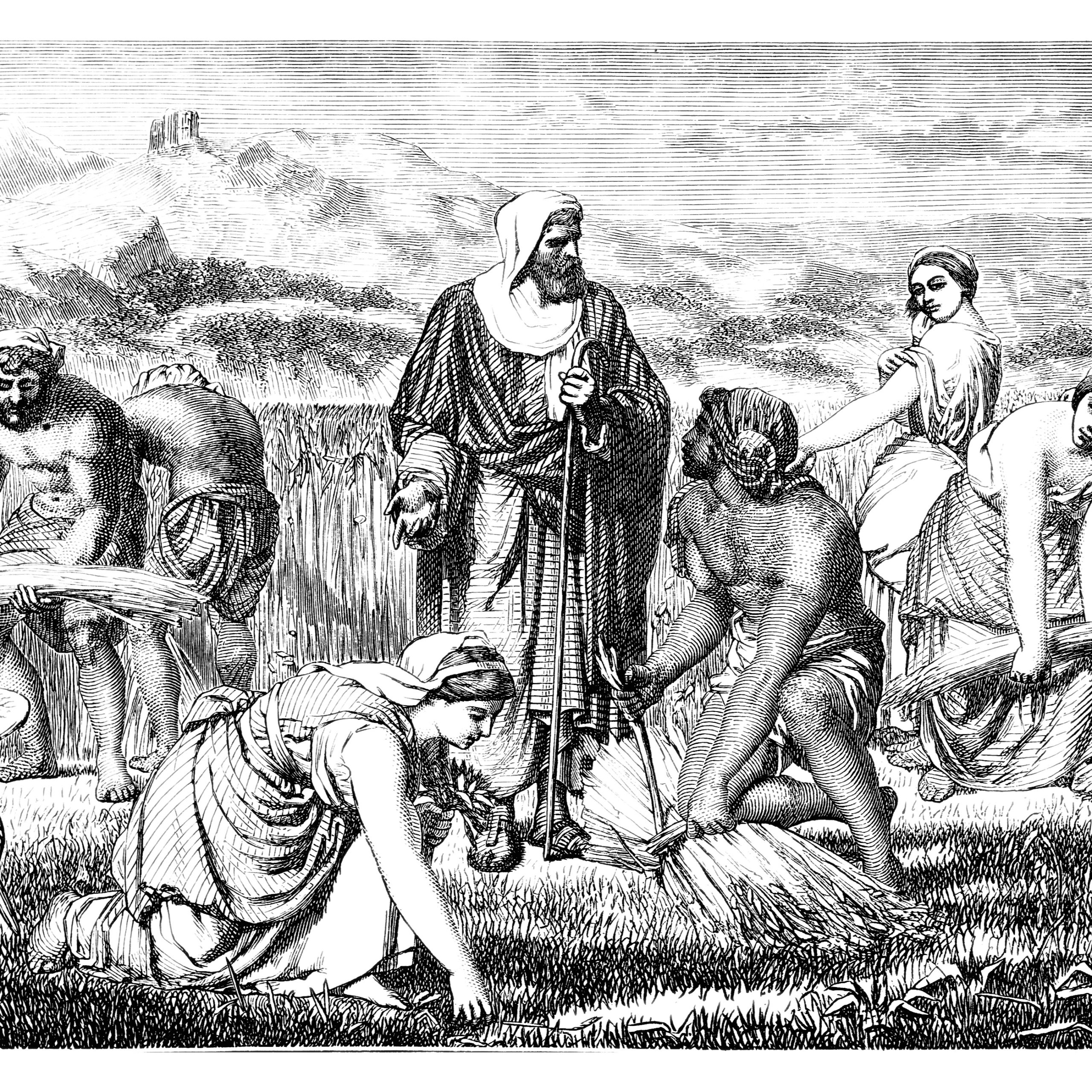
[00:29:36] She goes to the fields and she's gleaning.
[00:29:39] That's common.
[00:29:41] Boaz sees her and she kind of catches his eye a little bit, and he treats her with great favor and he tells the people, let her glean the fields. And in fact, leave some intentionally behind for her and maybe even pick some and lay it on the ground so she can pick him up, make this easy. Let's take care of her, and asks, who is she?
[00:30:08] And when they explain that she is the Moabite that came over, he is impressed.
[00:30:15] You can see that she has redeemed the image of Moabite, at least in her case. In this Idea that she has forsaken her God, she has forsaken her people.
[00:30:26] And she has shown Israel that she has made up for the sins or redeemed that past history by giving bread to the Israelites in a time of need and giving them passage into her home in a time of need, which were the two sins that had forsaken Moab. And she was willing to give everything up to come into Israel. And so they look at her not with the disdain, but she's looked at as an example.
[00:30:56] They're impressed. Boaz is impressed with her, and the people are impressed with her. And so he wants to help her out. And through Boaz, she's going to find her way at the center of Israel. And this story is telling us because it's interesting.
[00:31:14] Christ line is going to come through Ruth and Boaz.
[00:31:20] That means that Christ is going to have Moabite blood in him.
[00:31:24] So he's not just born from Abraham. Christ is also coming from Lot, which is why Lot still plays a prominent role in the Bible and has his place because he is part of Christ's line.
[00:31:39] Christ descends from Lot through Ruth and the Moabites is as interesting as that history is, and as back and forth and gray as it gets. Still, through Ruth's example and her righteousness and being brought in, she also plays a role in creating the Savior. The Savior is not just a Savior from just the Israelites, but also from the outside woman. As we look at women as symbolic of nations, outside nations, Gentile nations. That's what Gentile means, is nations and the outside of Israel, outsiders. So he descends also from an outside nation, outside of just the line of Israel, if you will.
[00:32:23] All right.
[00:32:27] When Ruth tells Naomi about how generous Boaz has been, and they realize that Boaz related is kinsman, and he's not just the next of kin. Though Ruth and Naomi are talking and this gets a little bit interesting, it can be interpreted a little bit strange.
[00:32:49] Naomi tells her to show interest in Boaz when he's done gleaning. He's going to be over there. Boaz, he's obviously interested in her. And he's saying, don't go glean at any other field. Just stay in mine. I'll make sure you're okay. I'll take care of you. Also very interesting that you compare that to Elijah, who looks at the. The Tishbite, the woman who's not Israelite, and he promises her that her meal will never fail because of her generosity in feeding him. This is. This is a very similar Deal.
[00:33:21] Boaz is looking at her, and she redeemed his family, his kin, by giving them meals in a time of famine. She gave of her bread to feed Israel to her own deficit when she comes in poor and not having anything.
[00:33:40] And so he is providing her with a meal that will never fail. Come take of my crop, and I will provide you with a meal that will never fail again. Think about this. When the time comes to the Gentiles at the end, when God is going to restore his gospel, he is saying that the food, the gospel, the. Not just the word of.
[00:34:00] Not just the bread, but the word of God will never fail. The meal will never run out. You will always. The. The gospel will never again be taken from the earth after he restores it through the Gentile nations, through the. Through an outsider.
[00:34:15] All right, I hope you guys are tracking.
[00:34:21] I miss Nate being able to help me out on this. Anyways, she tells Ruth.
[00:34:29] Naomi tells Ruth to go to Boaz and to uncover his feet and lay at his feet as a sign that she is willing to be with him and willing to subject herself to him.
[00:34:45] And Boaz sees this.
[00:34:48] And Boaz is a little bit older.
[00:34:50] He's already kind of done his deal and been in his prime. And he sees this as another sign of dedication and faith on Ruth's part. She's young. She could marry anyone from Moab, but she left those people to come to Israel.
[00:35:05] Israel.
[00:35:07] She's going to him because he is a kinsman. He's not the nearest kinsman. So she's not just going to sleep with them or go all the way yet.
[00:35:18] She's just showing that she is interested and wanting to take this to the next step, to follow this Israelite idea of being a next of kin.
[00:35:28] And Boaz doesn't want to make this scandalous. And he sends her away with food in the morning. So it's not just that she stayed over. I don't want people to think the only reason she came was just to lay with me. She's coming for food, and I'm going to send her back with food to take care of her mom and kind of switch the focus of what this was.
[00:35:49] And he tells her, I would be interested in redeeming you, but according to law, there's one closer than I, and I need to make sure that he has the opportunity to redeem you before I step in and take over.
[00:36:07] So you get to this next of kin.
[00:36:12] And Boaz takes him to the gates of the city where the elders of the elders of Israel are And they can sit down and decide and discuss issues and make legal contracts and binding agreements.
[00:36:26] And he tells his kin, we've got Naomi here who has sold her land to be able to provide for her and for her daughter.
[00:36:39] Will you redeem the land?
[00:36:43] And the guy, because you are the next of kin. And the guy says, yes.
[00:36:47] And you think about this from what this means is he is going to pay the price of how much the land would yield going up into the year of jubilees to be able to take the land back.
[00:37:03] And the reason why he would do that, why that would benefit him, he is going to be out money. But because Ruth is a widow and she does not have anybody, there is no one to inherit that land, then he can take possession of the land. So it is going to be an inheritance added to him as he redeems the land to this family. There is some benefit there.
[00:37:27] Then Boaz says, that is great that you are going to redeem it. Let me further explain that she has a daughter who married her son, that if you are going to redeem the land, it should have been the son's land, because when the father died, Elimelech died before Machlon, it became Machlon's land. This is his land that you're redeeming.
[00:37:54] If you're redeeming his land, then according to the Levite marriage, the laws, you should marry his wife and raise seed up to her.
[00:38:05] And what that means is if you have a child with Ruth, then he will inherit the land. So now you paid the price to redeem the land, but instead of inheriting the land and keeping it and having it for your financial gain down the road, and to be able to divide that property out among your children, you have to have a children through Ruth. And that child has to inherit the land so that the name of Machlon and Chilion, excuse me, Machlon and Elimelech will continue on. That will be their land, their inheritance and their family. So you don't get to keep the land, you are just paying the price without inheriting it.
[00:38:45] When he understands that piece of it, then it is no longer interesting. He can't afford to do that because he is going to be paying for something that will never pay itself back off.
[00:38:56] And this is where Boaz steps in. And the Hebrew word they use here is goel, which is redeemer. The next of kin is this Redeemer who is going to redeem the land, pay the price so that the land can shift back. And not only that, but redeem the family line. By giving them seed.
[00:39:15] And think of the Scripture in Isaiah when they're talking about Christ, who shall declare his generation, for he was cut off from the land of the living. He doesn't get to have seed. But when you make his soul an offering for sin, he shall see his seed. He shall inherit seed. This idea of being able to have children now and more are the children of the wife of the baron than the wife of the married. So here, this seed, this line is going to be restored to Ruth through Boaz.
[00:39:46] And the line of Christ is going to come through here, through this redemption that Boaz is offering.
[00:39:56] And interesting enough too, Boaz is the name of one of two pillars in front of the temple at Jerusalem. So Boaz is not just a source of strength, but also you look at the promises in the Book of Revelation, for the righteous, they shall be a pillar in the house of the Lord, nevermore to go out. And that's what Boaz is in this story.
[00:40:16] He's a strong person who's not doing this to seek his own gain, but to try to do the right thing and redeem his family and make things right for Ruth and Naomi and his kinsmen who have passed away, redeem their family. After all the mistakes or everything that they went through in the death of their family, there will be life again. They will be restored. They will receive an inheritance in Israel, and they will have children and life and continue on through the redemption of Boaz. So it's a beautiful story of redemption. And I think I've probably spent too much time on this already.
[00:41:00] That's all I'll do. Let's jump into the Book of Samuel. Yeah. Sound good? You guys with me so far? Did I put you to sleep? Hang in there.
[00:41:09] In Samuel, you have a man named Elkanah.
[00:41:13] El means God. Kanah means purchased. So God has purchased, and he has two wives.
[00:41:20] And the name of one is Hannah, which means grace, favor, or mercy.
[00:41:25] And the name of the other wife is Peninha. And Peninha means a jewel.
[00:41:36] So I look at this, and I see the jewel, Peninhah as almost like the house of Israel.
[00:41:46] This is his jewel. The people that he loves.
[00:41:50] And they're able to have children and posterity, the children of the covenant. God's going to make children as the stars of the universe or the sands of the sea. That shall be the children of Abraham.
[00:42:01] They are the covenant people and.
[00:42:05] And the jewel. So when Christ comes in the New Testament and he is at the table, and the Gentile woman comes and asks him to have him teach her. And he says, I haven't come to you. I have come to his jewel, his people, to Israel, to Abraham.
[00:42:23] And she says, well, even dogs get crumbs off the floor.
[00:42:28] And he was impressed by her faith. So I look at this other wife who is not able to have children, and I think of this as another nation.
[00:42:39] As you look at the process of birth being like the atonement, a rebirth. And the Lord has a covenant relationship with the nation. They are able to produce offspring to God, followers of God, people that are born again, people that are born to be able to follow Him. The Gentiles don't have that capability.
[00:42:57] Whereas in the jewel, the house of Israel, they do through the covenants from their fathers from Abraham, Isaac and Jacob.
[00:43:04] That's kind of how I see this, as we're talking about these two wives, one being Grace and favor, and the other one being the jewel. And the jewel is able to have children where the one that is grace and Favor does not have children.
[00:43:18] And when you say God has purchased Elkanah the husband, he's purchasing Grace or Favor so that he can bring these people into the covenant, into the house of Israel, and save them all.
[00:43:31] That is what this story is going to mean to me. Because Hannah is going to get a son, and she is going to have seed. And this story of women who so desperately want a child but can't have one plays a role. So predominantly throughout the Scriptures, over and over again, how many times have we heard this story? And we will still hear it before the Old Testament is done, repeated several times over.
[00:44:02] It's a very common theme. So she wants to be blessed. She wants to have children. She wants the Lord to have that grace and favor on her, that she can bring seed to Him.
[00:44:14] But initially she's not able to.
[00:44:17] And I see that as God saying as he purchases grace and favor, that he will bring them. And I go to Isaiah, chapter 54, for more are the wife the seed of the wife of the barren, than the wife of the married. So even though the wife of the married has children, there is going to come a time when the other one will have children, will be brought into the covenant of the Lord. God is not just a God of Israel. He is a God of all the earth. And he will bring children into him from every nation, from every people.
[00:44:51] He is not a respecter of people. He is a respecter of covenants. And for those that choose God, he will love them and guide them and bring anyone in that wants I see that as kind of a prevalent theme in this story, honestly. A prevalent theme in the story of Ruth that we just read and the story of Rahab that we've read and the story of.
[00:45:20] I mean, it's all throughout. Anyways, I've said too much on it anyways.
[00:45:27] So Hannah, she gets a worthy portion is what it says. And it's kind of funny how they say worthy portion because they use the word nose.
[00:45:37] So Elkanah gives portions to Penina and her children, but to Hannah, he gives a nose portion. And you're like a nose portion. Usually they use the Hebrew word nose like nostrils as they're flaring to signify anger.
[00:45:52] So the anger of the Lord waxes hot. They're talking about the Lord's nose.
[00:45:56] In this case, it's not an angry portion, and it's not a nose portion, but it is translated as kind of a worthy portion, an extra portion, or something that's a little bit more in addition to.
[00:46:09] It's just kind of a weird way of saying it from the Hebrew that gets in there.
[00:46:17] Verse 5 of Samuel, chapter 1. But unto Hannah he gave a worthy portion, for he loved Hannah, but the Lord had shut up her womb and her adversary. And the Hebrew word adversary here is your rival wife. I mean, it's such a common theme in the Old Testament that it even has its own word, like the rival wife is a word in Hebrew. The adversary also provoked her sore to make her fret because the Lord had shut up her womb. And as she did so year by year, and she went up to the house of the Lord, so she provoked her. Therefore she wept and did not eat.
[00:46:56] And so Elkanah was sad. It's hard to see your wife sad. And it's really hard to see her sad because she can't have children. Because what can you do when you see a woman weep and is sad and there's nothing you can do to help her, and you're doing everything you can, it makes you feel really sad as well.
[00:47:19] Jacob was. Was beyond sad when Rachel wanted to have children. And she's like, look, if you love me, have kids with me. And he's like, I. What? What do you want me to do? God? Shut up your womb.
[00:47:30] You. And. And so Hannah, she. Verse 9. So she rose up after they had eaten in Shiloh, and after they had drunk. Now, Eli the priest, sat by the seat of a post of the temple of the Lord, and she was in bitterness of soul, and she prayed unto the Lord and wept sore.
[00:47:49] What a great Way of saying that in bitterness of soul and prayed unto the Lord and wept sore.
[00:48:01] In those raw moments of emotion that bring us to just plead and bear out our soul and bitterness of soul to weep weeped ourselves sore.
[00:48:13] There are such beautiful moments, and you hate to go through that.
[00:48:17] But what a prize to pull out of a moment like that. You know those moments where you are praying and you feel good, that type of prayer just feels so profound and so deep. And it is not typically a prayer that you can offer up when everything feels good. It is a prayer where you are feeling destroyed and taken back.
[00:48:44] And to add insult to injury, the priest kind of reprimands her a little bit and says, are you drunk? And he doesn't understand. He says, and Eli said unto her, how long wilt thou be drunken? Put away thy wine from thee.
[00:49:02] Kind of, kind of sore judgment.
[00:49:06] And the priest here is not getting a lot of great space.
[00:49:11] Not only does he not put in a good light here in not understanding the situation and not being more sensitive and coming across as kind of a simpleton, but he is going to be put in a bad light. When you look at how he was raising his kids because his two sons were using the priesthood to try to benefit themselves and try to get something more from it, rather than trying to give the choicest meat to God or to each other, to someone else, or however this is going to work, they would try to work it to where they were choosing and picking and choosing the best parts for themselves. They cared more about themselves than they did others. They cared more about themselves than they did God.
[00:49:52] And they were intentionally doing the ordinances wrong to please themselves rather than to please God.
[00:50:02] And Eli looks bad because he permits it.
[00:50:06] He doesn't say anything. He doesn't call them out. He doesn't reprimand them. Yet he's going to reprimand this woman for something that she's not doing. He's going to be quick to correct someone who's not his responsibility and step in and say something when he completely misses what's in front of his own nose. I mean, when Christ comes and says, take care of the beam that's in your own eye before you fix the mote in someone else's.
[00:50:33] This is kind of an ideal situation where you see that.
[00:50:36] But in Hannah in her sadness, and she's praying out her soul in verse 11, and she vowed a vow and said, o Lord of hosts, if thou will indeed look on the affliction of thine handmaid and remember me and not forget thy Handmaid, but will even unto thine handmaid, but will give thine handmaid a man child, then I will give him unto the Lord all the days of his life, and there shall no razor come up upon his head.
[00:51:02] So she's talking about sacrificing her son. There's a couple instances where we see this in sacrificing the son or sacrificing a child, Abraham sacrificing Isaac.
[00:51:14] In Judges, there's a story of one of the heroes that says, I will sacrifice whatever comes out to meet me on my way home. And he had to have known it was his daughter. Who else is going to be excited to run out to meet him? Maybe the flocks, I don't know. But his daughter runs out and he sacrifices her. But as you see in the story of Hannah, to sacrifice a child isn't necessarily mean that you are going to be taking away their life, but rather dedicating them to the Lord. And Samuel is going to be dedicated to the Lord, not only from his wife's perspective, but when God calls Samuel, the voice of the Lord from the temple calls Samuel. And he says, here am I, Hinnony. Behold me. I am here, look at me. I will serve you.
[00:52:03] So he is willingly going to go serve the Lord. And what a sacrifice for Hannah, who wanted so much to have a child and to raise this child, to give that up and raising him, if only it meant that she could at least have a child.
[00:52:19] So she makes this covenant, and one of the most impressive things about her is the faith that she has, which rivals that of Abraham, believing in the impossible. Because here she has. She's tried everything to have a child.
[00:52:35] But then look at in chapter one, verse 17. Then Eli answered and said, go in peace, and the God of Israel grant thee thy petition that thou hast asked of him.
[00:52:50] So faith comes by hearing and hearing by the word of God. Eli is the priest, and in the Lord's name he tells her that you will have a child.
[00:53:04] And she believes. And you can see that she believes when you look at verse 18. And she said, let thine handmaid find grace in thy sight. So the woman went her way and did eat, and her countenance was no more sad.
[00:53:21] Can you believe that?
[00:53:22] Well before she even had a child, she stopped fasting.
[00:53:28] And her countenance was sad, not because she had a child, but because she believed the Lord. And the priest that spoke in the name of the Lord, if he said that she was going to have a child, that was enough. Not the act of Having a child, but simply being able to believe in his words. Even though it was impossible, even though she had tried over and over again and it didn't seem possible. If the Lord said it, that was enough for her. She would believe it. Their countenance was no more sad.
[00:54:01] And they rose up in the morning early and worshiped before the Lord and returned and came into their house to Ramah. And Elkanah knew Hannah, his wife. And the Lord remembered her.
[00:54:12] Wherefore it came to pass when the time was come that after Hannah had conceived that she bare a son and called his name Samuel. In Hebrew, Sam or Shem means name. El means God. His name is God. El is his name.
[00:54:26] So she kind of names him after God, I guess, because I have asked him of the Lord. And the man Elkanah in the house went up to offer unto the Lord yearly sacrifice and his vow. But Hannah went not. For she said unto her husband, I will not go up until the child be weaned. Because every year they would go up and offer their sacrifices. Well, Samuel was going to be one of those sacrifices. So she did not want to go up to offer a sacrifice until the child had been weaned. Because he was going to be one of the sacrifices that she was offering to the Lord. And so she held onto him and weaned him for as long as she could. And when he was ready, she brought him. And look at how she says this in verse 24. And when she had weaned him, she took up with her three bullocks and one Ephah of flour and a bottle of wine and brought him unto the house of the Lord in Shiloh.
[00:55:18] So just like all of the animal sacrifice and what she was doing, she brought him up as a sacrifice just as much as any other sacrifice. He was being brought up to sacrifice to the Lord. That did not necessarily mean that he was getting killed. He was sacrificed in a different way.
[00:55:36] In a way that he was sacrificed from her being able to raise him. And being his mom to now he is going to be at the house of the Lord and to serve God and to be the Lord's servant.
[00:55:51] And they slew a bullock and brought the child to Eli. And she said, o my Lord, as thy soul liveth, my Lord, I am the woman that stood by thee here praying unto the Lord for this child. I prayed, and the Lord hath given me my petition which I asked.
[00:56:07] Therefore also I have lent him to the Lord. As long as he liveth, he shall be lent to the Lord. And he worshiped the Lord there.
[00:56:16] It is a beautiful story. It was a story that inspired my wife quite a bit. And I probably don't need to tell that story. But I think Hannah has a special meaning to a lot of us and a lot of people that worry that maybe the Lord has forgotten us or maybe the Lord is not giving us a blessing that we want so bad and so desperately, to the point where maybe we think it is impossible.
[00:56:43] Not even just in temporal blessings or blessings of having a child, but maybe we think sometimes in our life is salvation beyond our reach. We want to be perfect. We want to put aside our sins. For so long we have been struggling to set them aside to the point where we think, you know what? It is impossible. I have tried and I have given up on this.
[00:57:05] But instead of giving up on this, she continues to go and to plead her case before the Lord and finds that her belief in the impossible was justified and that it was possible for her to be redeemed, to be saved, and to have a child. So I do love the story of Hannah.
[00:57:24] And she sings praises. So chapter two, we get kind of this song and she takes care of her child and the Lord's going to call him. And we have that story. When the Lord calls, Eli answers. And I love. We'll just read verse 21. I know I'm kind of running, running out of time here.
[00:57:41] And the Lord appeared again in Shiloh, for the Lord revealed himself to Samuel and Shiloh by the word of the Lord.
[00:57:52] Here you have not just a priest in the temple and whatever, but the Lord appearing to a prophet again. And Samuel is going to be playing a very central role in unifying Israel and taking them to the next phase where we went from patriarchs to these patriarchs, prophets. That kind of took them into a next dispensation where Moses and Joshua to this period of Judges. And then we're going to have a transition from Judges to kings. And Samuel's the one who's going to be anointing the kings, who is going to start with Saul and then also with David. And we're going to get into a new epic era, time of Israel's history. And Samuel is that key piece as we get there. So we'll talk more about Samuel next week. We'll pick back up right in the book of Samuel, talk about some of the things that are happening. Eli and his sons and what happens with their family. As you can see in these chapters, it's prophesied that they're going to be destroyed and that The Lord is going to raise up another priest to be righteous. So we'll leave off right here for now, for this week. But let me leave this with you. Also in the Book of Judges, there were a lot of stories that we did not get to and some stories that maybe do not have a ton of value.
[00:59:15] And when we just read them, they seem a little bit gruesome or a little bit hard to understand or difficult. And the church, I feel like with good reason, kind of leaves them off the come follow me discussion.
[00:59:26] But because it's left off the come follow me discussion and it's not talked about and because it's kind of hard to read and understand, when you talk about the gore or the violence or some of the things that are happening, you're like, why is this included in the Bible? And if we can't talk about it in church, where when can we talk about it? I do have some comments. I would like to revisit some of those stories with in particular Leviticus 19 when you're talking about the Levite who's coming and his concubine is taken and abused and killed and the destruction of almost all of the Benjamin until you have only 300 men left over and you've got the story. We mentioned it briefly in this episode of the judge that offered his daughter up as a sacrifice. So I do have some thoughts on those that we just did not have time for. If you would like a bonus episode or for me to try to explain some more of that, let us know. I know these next two weeks we're going to be a little bit tight on time, but if there's enough interest in that and you'd like to hear a little bit more kind of touching on some of those things that we skipped, it doesn't even have to be judges if in your own reading and we're going through this at such a fast clip trying to keep up with come follow me, you'll notice that something got skipped or left out that you would love for us to discuss or you'd want to hear our take.
[01:00:44] Please reach out to us. You can post comments on our
[email protected] you can send us emails. Hi, @weeklydeepdive.com we've got a Facebook page, Add On Education.
[01:00:59] We even have an Instagram that we don't really use. I'm terrible at social media, but reach out to us any method you want. Or if you just know us, text us, call us, let us know. And in the next coming weeks we can put together some bonus content for you or bonus episodes to kind of talk about some of the things that fall by the wayside.
[01:01:19] We would love to do that for you. Hope you enjoyed this episode. We look forward to having Nate back next week. And until then, see ya.