Episode Transcript
[00:00:00] Speaker A: Foreign.
Welcome to the weekly Deep Dive podcast on the Add On Education Network.
The podcast where we take a look at the weekly Come follow me discussion and try to add a little insight and. insight and unique I am your host, Jason Lloyd, here in the studio with the one and only Nate Pyfer Hey, Nate.
[00:00:35] Speaker B: What's up, buddy?
[00:00:36] Speaker A: Dude, I, I am beyond stoked to get into Isaiah. Isaiah's fun.
It's a lot of fun.
[00:00:44] Speaker B: Oh, I can tell that you're stoked.
[00:00:46] Speaker A: Yeah, I, I, I'm just super excited. I'm, I'm chomping at the bit. Isaiah's.
I don't know.
This is going to be fun. We're getting into a new section of the Bible. We're leaving.
It's a great transitional because we're going from the poetics, psalms and proverbs and Ecclesiastes into the prophets. And Isaiah is a great transitional prophet because that guy was a master poet and he would use his parallels very well.
And he was such a wordsmith. I don't know.
He puts Shakespeare to shame.
[00:01:23] Speaker B: Whoa.
[00:01:24] Speaker A: Yeah.
And there's words that he would invent.
And so if a word only shows up once in all of the Bible, it's called a hapex or Hapex Legomenon.
Yeah.
And a lot of these show up in the book of Isaiah because of how inventive and cool he was with words, and he had a way of saying things. So I.
And prophetic, the, the things that he saw and prophesied. I. Hats off to Isaiah.
[00:01:54] Speaker B: Okay,
[00:01:56] Speaker A: but before we dive into Isaiah, we. We sat down a few weeks back with, with the nice cult and did a podcast episode with those guys.
[00:02:06] Speaker B: Oh, yeah, that was great.
[00:02:07] Speaker A: That was a lot of fun. And their episode is out now, so.
[00:02:10] Speaker B: Oh, the. We're on.
[00:02:12] Speaker A: Yeah.
[00:02:12] Speaker B: Yeah, baby.
[00:02:14] Speaker A: Yeah. The mom. I joined a cult.
[00:02:16] Speaker B: Yep. If you want to hear. If you want to hear about Monty Python and the intricacies of actual, like, religious history peppered into the entire Monty Python in the Search for the Holy Grail movie and just some other general absurdity.
[00:02:32] Speaker A: Yeah, it's a little less structured. We're not having a come follow me curriculum. We're following just kind of a fun little chat conversation with some really cool dudes.
[00:02:40] Speaker B: Yep. Go listen to it.
[00:02:41] Speaker A: Yeah.
All right. Anything else, Nate, Pyfer I dive
[00:02:45] Speaker B: in? Let's see.
Not that I can think of. Let's get into Isaiah.
[00:02:49] Speaker A: Oh, let's do it. Because we're going to use up all the time with this one.
[00:02:53] Speaker B: Buckle up, everybody.
[00:02:55] Speaker A: Okay, Isaiah, let's just go right into chapter one.
[00:02:59] Speaker B: Okay.
[00:03:00] Speaker A: And verse one is just giving us a little bit of context. The vision of Isaiah, the son of Amos. So who he is and then which he saw concerning Judah and Jerusalem and the days of Uzziah. Excuse me, Uzziah, Jotham, Ahaz and Hezekiah, Kings of Judah.
[00:03:16] Speaker B: Okay,
[00:03:18] Speaker A: context being out of the way, let's dive into this right off the bat. Verse 2. Hear, O heavens and give ear, O earth. So look at that poetic parallel. Hear, parallels, give ear, O heavens.
And now we're saying not synonymous with heavens, but earth is matching heavens in the sense that all of the heavens and all of the earth. In other words, everybody listen up.
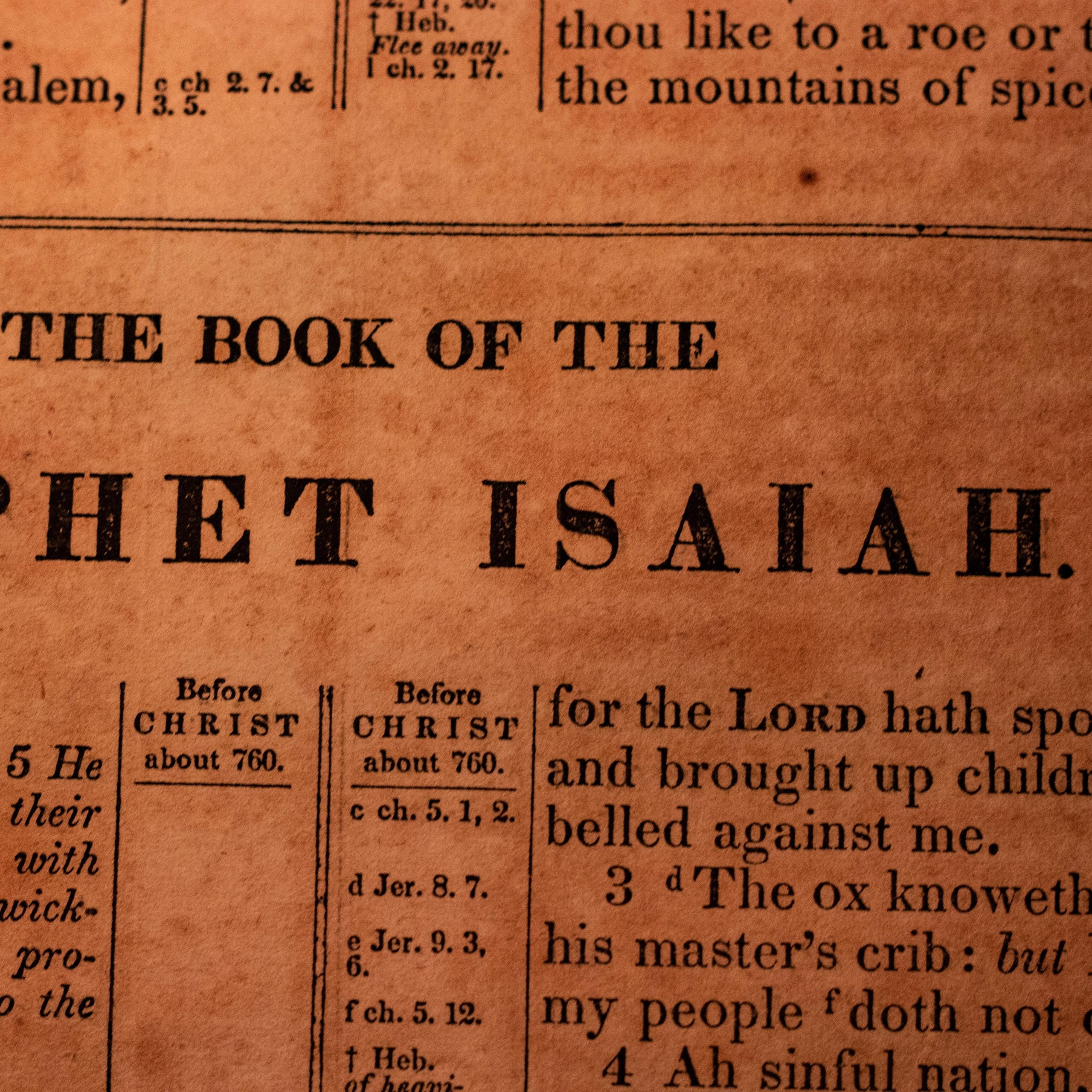
For the Lord hath spoken. I have nourished and brought up the children and they have rebelled against me.
And this is an instance where we have Isaiah's writings here, where he is speaking in the name of the Lord, I have done this. So in other instances we're hearing about how the Lord was angry, or the Lord was this, or the Lord whatever. And here Isaiah is speaking in the name of the Lord what the Lord is saying. And he's got a very close relationship with God. And as a prophet, he speaks for the Lord.
And the context he's brought and nourished up these children and they've rebelled against him is going to be the subject of a lot of what Isaiah is going to be writing about throughout the entire book. So. So it's a decent introduction.
Now verse 3. The ox knoweth his owner. And if you want to just circle owner in Hebrew, the word for owner is purchaser, the one that bought them, which is the same as owner. But I kind of like the sense of someone who's purchasing them, redeeming them. Right.
So the ox knoweth his owner and the ass his master's crib.
And crib is such a terrible translation here.
[00:05:06] Speaker B: Not like MTV cribs.
[00:05:07] Speaker A: Yeah, like how many donkeys do you know that you like, you tuck them in a crib and like, good night.
[00:05:14] Speaker B: Isn't it just their house, their crib?
[00:05:17] Speaker A: Yeah, no, this one is actually a feeding trout.
[00:05:20] Speaker B: Whatever.
[00:05:21] Speaker A: But I mean in modern day context, yes, crib house, where they reside. But in this, the Hebrew word is a feeding trough.
So the ass knows where he gets his food and the ox knows his owner.
And you can see the parallel nature of this ox parallel with ass. Knowing is implied in the second verse. And then you have a purchaser and where you get your food from the one that's feeding you.
But Israel doth Not know, my people do not consider. So you can see that poetic nature continuing on. Israel in parallel with my people does not know.
Parallel with, does not consider.
But what you might pick up on is that these two lines are also in parallel with each other, right? Because you're not saying Israel doth not know its purchaser, Israel doth not know where its feeding trough is. That's implied.
And because it's tied to the top two lines, what else is also implied is Israel is being compared to an ox and an ass.
So if you look at all of the animals that are out there and like, you know, you have those quizzes, what kind of animal are you? And you're like, oh, I hope I get a bear or a lion. Nobody's like, please, please, I'm hoping for an ass, right? And Israel is being compared to an animal that's not necessarily a bald eagle or this glorious lion. It's being compared to a beast of burden. Which kind of gives us some expectations of what the Lord has. Like I called you like Christ when he came here on earth and he's washing the apostles feet, feet. And they're like, whoa, whoa, whoa. You shouldn't have to be washing ours. We should be washing you. You're this glorious guy, this great guy.
You should be getting all of the credit and the praise and be putting up on a high pedestal and we should be serving you. And the Lord's like, you don't get it.
I'm not here to be served, but to serve. And the greatest in the kingdom of heaven. Because they keep asking like, who's going to be greater? You know, I'm the greatest, right? We did some good things here. We should be first, right? We get first dibs on heaven. We're the coolest people here.
And Christ grabs some little innocent kid off the street and says, this one right here is the greatest because of how humble he is.
If you want to be the greatest, it's about serving my people. I'm not calling you to make you some eagle, to make you some lion that's going to tread through the earth and destroy everyone. And everyone's going to be like, wow, look how amazing and powerful they are. If you want to be like me, I'm coming and showing you how to be like me. I'm going to come by serving, by being an animal of utility, by being something that brings service and value to the rest of the world.
But these animals.
So also if you go to the hierarchy, because you can see this with Balaam, right? With Balaam you've got this hierarchy of people where the prophet who speaks in the name of the Lord is considered high or holy. You've got your priest class, you've got your regular people, you've got your servants, and then you've got these animals. And even in the animal kingdom, you've got these cool animals, and then you have the beasts of burden. And that's kind of like the lowest, the bottom of the rung here. And so when you have a donkey that's speaking in the name of the Lord and you have that role reversal, think again. Israel's being compared to the lowest of the lows and saying, even the lowest of the lows understand who I am and what my role is. And you guys, who are supposedly supposed to be the exalted people, the chosen people above everyone else, like this prophetic people that's supposed to be a light to the world, you're even lower than the lowest of the animals.
So there's a lot of imagery going on here. There's a lot of symbolism going on here, and also there's a little bit of prophecy going on here, because you can't have Isaiah without prophecy. When Christ comes and the Jews are looking for a Messiah, the ox knows who the Messiah is going to be. The ass knows who the Messiah is going to be. The ass is bearing Christ into Jerusalem on his back.
But guess what? My people aren't going to know who the Messiah is going to be. They're going to miss it.
[00:09:47] Speaker B: Great.
[00:09:48] Speaker A: All right, so that's this verse I know I spent a little bit of time on here, but I love verse three, and I love what the Lord's going to continue saying here. He's going to start condemning them a little bit. O sinful nation, a people laden with iniquity, a seed of evildoers, children of the corruption that have forsaken the Lord. And he's going to start accusing them and talking about what they're doing wrong.
And a lot of what he's going to accuse them of is beating down the people that they should be helping and not.
What's the. Well, maybe I should read some of this a bit.
Why should you be stricken anymore? You will revolt more and more. The whole head is sick and the whole heart is faint. And they're saying the nation is sick.
Verse 6. For the soul to the foot, even unto the head, there is no soundness in it but wounds and bruises and putrefying sores. That's pretty descriptive.
And they have not been closed, neither bound up Neither modified with ointment. Your country is desolate. Your cities are burned with fire. Your land strangers devour in your presence and is desolate, overthrown by strangers. They're saying all of the nation has not escaped. There's no soundness in any of it from head to toe. Your country is pretty messed up.
The daughter of Zion is left as a cottage of vineyard, as a lodge in the garden of cucumbers, as a besieged city. Except the Lord, the host, had left us a very small remnant. We should have been as Sodom and we should have been likened to Gomorrah. And this is kind of an interesting thing to say.
He's saying that there's a remnant that escaped.
And when Assyria comes and destroys all of Israel, Jerusalem and Judah somehow survives and they escape that destruction and that makes them feel invincible. When Babylon comes, they don't think they're going to fall. That great city can't be destroyed because we survived the Assyrians. We're not going to fall. This is God's city. And yet they do get destroyed. And yet a small remnant is going to come back. And this remnant is prophesied about. And you can see it way back, thousands of years ago with Joseph and the coat of colors, which becomes a prophetic story.
And the nature that his coat representing Israel, is torn by the beast. Well, that's what his brothers are saying, right? Really, the brothers have sold him out and they have destroyed him. Israel sold themselves out and they tear this up. But there's that one remnant of the coat that doesn't fade, that doesn't get destroyed, that doesn't perish.
And if it wasn't for that remnant, then they would have been like Sodom and Gomorrah, just a footnote in history, because they wouldn't have continued to exist. No one would know anything about him.
And this is where I see God's sense of humor, or Isaiah's sense of humor. Verse 10.
Hear the word of the Lord, ye rulers of Sodom. Give ear unto the law of God, ye people of Gomorrah.
So he's speaking to Israel, and yet he's calling Israel Sodom and Gomorrah. And you see that poetic parallel again. Sodom has been parallel with Gomorrah. Hear the word of the Lord. Give ear unto the word of the Lord. And now he's referring to Israel as Sodom and Gomorrah. You're just as bad as them.
And this is where it gets scary, Nate.
To what purpose is the multitude of your sacrifices Unto me, saith the Lord, I am full of the burnt offerings of rams and. And the fat of fed beasts. And I delight not in the blood of the bullocks or the lamb or of the he goats when you come to appear before me. And this is actually a mistranslation. In the Hebrew, it actually says, to see my face. When you come to see my face, think of the high priest who's allowed to go into the holy of holies, the presence of God before his face on the mercy seat. Who hath required this at your hands to tread my courts, to go into my temple, bring no more vain oblations. Incense is an abomination unto me. The new moons and the sabbaths and the callings of assemblies, I cannot away with is iniquity. Even the solemn meeting, your new moons, your appointed feasts, my soul hateth. They are a trouble unto me. I am weary to bear them.
In the temple. You have your sacrifices, you offer your burned incense, you go into the holy of holies.
All of these holidays and these feasts and these things that the Jews are observing, and God is saying, I'm sick of it.
That's a weird thing for God to be saying. And what does that translate to?
Look at.
Look at the Book of Mormon.
When Nephi is talking to his brothers and Lehi says, hey, we've got to go. We're leaving the city. It's going to be destroyed.
Laman and Lemuel say, we know that they were a righteous city.
And how do they know that it was a righteous city? And they're saying, they observed the laws, they observed the rights. And this is what God's saying right here in Isaiah. Isaiah is not too much earlier than Lehi, the same time period. He's saying, yeah, you're doing these things, but it's an abomination to me. And if you try to translate that into modern terminology, if you have somebody that says, yeah, I'm paying my tithing, I'm going to church, I'm following my callings, I visit the temple, I do my ministering. And God says, yeah, and I'm sick of it.
Isn't that a backwards thing to say? Why would God ever be sick of you going to church and paying your fast offerings and paying tithing and doing all of the things that he's lined out in great detail in the law of Moses saying, you need to do all of these things and you do it, and yet God's sick of it.
And it's the same thing that Christ runs into in the New Testament.
Because when Christ goes, he's being criticized because some of his disciples are grabbing corn or as they're walking by and they're doing some work on the Sabbath or because they're not following the laws exactly how they should.
And so you're looking at a people that Christ is very critical of. But remember, these people that he's critical of are very observant in the law.
They're following the rights, they're following the rituals, they're offering the sacrifices, they're going to the temple, they're doing the things that they're commanded to do. Why are they wicked? And this is what I love about Isaiah 1 is it's maybe the only time you see in the Scriptures where it actually takes the Sunday school answers and turns them on their head.
Because so many times this is the right answer. Right? How do I. How am I supposed to be successful in life? Well, go read your Scriptures, go say your prayers, go to church, go attend your meetings, Go do all of these things that you know are good, and you'll be just fine. And then God says, hey, guess what? I'm pretty mad at you, Israel, and I don't want to see you doing any of these good things anymore. I'm throwing all of these Sunday school answers out the window.
So why would he throw that out the window? And why was Christ so mad at them in the New Testament if they were very observant in keeping the law that Christ himself had given them?
That's a good question, and it's one that needs to be answered. So Isaiah is going to provide that verse 15. And when you spread forth your hands, I will hide mine eyes from you.
I think we've talked about this a little bit when we're talking about prayer in the ancient world. You prayed with your hands. So you spread your hands out. It was a sign of prayer or part of a prayer. And he's saying, I'm not listening to your prayers. I'm not watching your prayers.
Done with it.
When you make your prayers, I will not hear you. And your hands are full of blood. And if you would like. So I'm in 15, right at the end of the verse, if you've got a pen handy and you want to put a note here, there's actually a little bit further in this verse that doesn't show up here in the Scripture. This is from the Dead Sea Scrolls.
And where you have you spread forth your hands is in parallel with prayers. I will hide mine eyes from you. And now after you pray, I will not hear you. So you have your eyes parallel with hearing. Now you're going to have two more lines in the King James. And what you're seeing, there's only one line. Your hands are full of blood. But if you go back to the Dead Sea Scrolls, in the Hebrew, there it says, your fingers with iniquity.
So then you have fingers in parallel with your hand, and full of blood is parallel with being full of iniquity.
Then he says, wash you, make you clean, put away the evil of your doings. From before mine eyes, cease to do evil, learn to do well, seek judgment, relieve the oppressed, judge the fatherless, plead for the widow. If this sounds familiar, it should. This is the same message that God gave to the gods in Psalm 82 when he talks about the unjust judge. How long will you judge unjustly and keep trying to please the wicked and the wealthy and the powerful and yet despise the poor and the needy and the widows and the fatherless? And that comes right back down to it. And if I were to sum up Isaiah, chapter one in the New Testament, Christ does a very good job of it. Actually, it might have even been Paul. You're probably a little bit better with the New Testament than I am, Nate. So if you. If you know what I'm talking about, feel free to correct me. But when he says, though I speak with the tongue of angels, though I do all of these great things, if I have not charity, then it mattereth not, or I am nothing. Right?
And correct me if I misquote that. But the idea is it doesn't matter how observant you are.
If you are missing that love, then you're missing the whole point.
And it's kind of cool that it's following Ecclesiastes and Song of Solomon and Solomon's writings, because Solomon went down that same road in Ecclesiastes, when he's saying, wisdom is all vanity under the sun, it might seem like it's great, but really, wisdom without God is nothing. It's not there. There's something more that needs to be a part of this. And if we're just going through the motions, we're saying our prayers, we're reading our scriptures, we're going to church, we're doing whatever we're doing, and the Sunday school answers and going through the motions, but our heart's not there and we're not engaged, we're not plugged in, and we're not doing it with love.
And specifically, when they say, learn to do well, seek judgment Relieve the oppressed, judge the fatherless, plead for the widow.
Come now, and let us reason together, saith the Lord. Though your sins be as scarlet, they shall be white as snow. Though they be red like crimson, they shall be as wool. If ye be willing and obedient, ye shall eat the good of the land.
What's going to heal them is caring for the people that are slipping through the cracks.
And that's a scary thought.
When the Sunday school answers start to fail you, and you're looking around and saying, have I not done good all the days of my life? And you look at that wealthy man that came to Christ and says, since the youth, I've been doing all of these things.
Well, sell all you have and come follow me. It's not just about doing good. It's not just about checking off a checklist of things that you have to do. How.
How do you find that person that needs you and who are the oppressed?
And oftentimes it can be as simple as the children in our home that need a little bit of love, that need a little bit of correction, that need a little bit of teaching.
Or maybe it's somebody who's out on the streets and we're surrounded by all sorts of terrible situations and people that are begging.
There are individuals that are being trafficked, that are out on the street, and we try to look away from them because that, to us, is dirty. It's something that we don't want to be associated with, we don't want to participate in it. And we're going to pretend it doesn't exist or close our eyes or walk around it or avoid it, or say, maybe some of those people there, they get what they have coming.
That's a consequence of their choices. And I don't want to associate with them. And yet we try to align ourselves with people that are wealthy or powerful or whatever. And this is a message that keeps showing up in the Bible over and over and over again, is stop sucking up to the people you think are good.
And this was a problem that the apostles had with Christ in his time. Stop sucking up to Christ and trying to say, who's the best in the kingdom? Am I good enough? Am I good enough?
And start looking around you and finding, how can I serve? How can I be this person? How can I be like the ox or the donkey that both understand their master? And why did Israel miss their master? Is because they were looking for somebody that was powerful, that was rich, that they could suck up to, instead of trying to find somebody who was going to be humble and coming to serve.
So it's an interesting message. It's very powerful. I love Isaiah 1. I've probably spent too much time in it.
If you want to finish that chapter, feel free to. It's just a very powerful chapter.
All right, next, Isaiah 2, 4 is actually one prophecy that kind of got broken up, unfortunately, into like three. Three chapters where it really should have just been one.
And it's a really interesting one.
This is the only prophecy that deviates from this prophetic.
What's the word I'm looking for?
There's a formula, prophetic speech in the Old Testament, and it follows this, this way. So Isaiah begins this prophecy in verse. So chapter two, verse one is normal. This is the word that Isaiah, the son of Amos, saw concerning Judah and Jerusalem. But verse two, and it shall come to pass. And that sounds like it's very prophetic, but this is actually the only prophecy that begins that way of Isaiah's. It doesn't fit. It's a little bit strange.
And it starts off by talking about, in the last days, that the mountain of the Lord's house shall be established in the top of the mountains, and shall be escalated above the hills, excuse me, exalted, above the hills.
And all nations shall flow unto it. And many people shall go and come, and let us go into the house of the Lord, or the mountain of the Lord, the house of God, Jacob. And it starts off very positive.
And in the prophetic speech, it never begins with the positive message.
It always starts with exhortation or the accusatory. This is what's going wrong. This is where you've wronged me. These are the punishments, these are the rewards.
And usually the rewards is how you wrap it up, never how it starts.
And so looking at how this differs from everything else that Isaiah has done, not only that, but when it says, it shall come to pass in the last days of the mountain of the Lord's house shall be established in the top of the mountains.
This is also found in Micah, word for word.
And so scholars look at this and they say, Isaiah, this isn't his style. This isn't prophetic speech.
This is a quote. Isaiah is taking the words of Micah and using a direct quote. And he's not claiming them necessarily to be his, but. But he's starting by quoting another prophet, talking about this promise, and then he's going to launch into the prophetic speech that he has, and then he's going to wrap it up full circle by talking about. So chapter four is going to finish exactly how chapter two begun to wrap this all into a full circle complete prophecy, because verse four, and it even uses the same language, the same verbiage. Verse 3, and it shall come to pass that he that is left in Zion and he that remaineth in Jerusalem shall be called holy. And now you're getting to that feel good warm and fuzzy promise that went full circle with the mountain of the Lord being established in the beginning. So Isaiah is taking another prophet, Micah, and he's quoting what he's saying, and then he's going to add a lot more context to what that prophet is saying to give people an understanding of what to expect.
And it's a great prophecy.
And I think it's very interesting that both Micah and Isaiah quoting Micah start off by saying in the last days. And when they say in the last days, they're not talking about now, and they're not talking about in the immediate future.
They really are talking about way down the road.
They say, the mountain of the Lord's house shall be established. And why I say that's so interesting is because in the time of Micah and in the time of Isaiah, that temple already existed.
So if they're saying it shall be established, that's implying that that temple will be destroyed and that it will be built again, because it's not going to be established in the end if it already existed this whole time. So there. That already you're getting some interesting prophecy here about the destruction and then the restoration of that temple.
Okay, there's, there's, there's a lot of little cool things in here, but maybe for the sake and interest of time to make sure we move through all of this, there's a lot of cool things to talk about in Isaiah.
I'm going to skip a little bit forward into Isaiah 4. 1 and talk about this verse, because this is all being quoted in the Book of Mormon in Second Nephi, by the way. And this is a verse I think most of us have heard and are somewhat familiar with, but maybe don't fully understand.
And it says, and in that day, seven women shall take hold of one man, saying, we will eat our own bread and wear our own apparel, only let us be called by thy name to take away our reproach.
And should I, should, should I, should I pause here, Nate, give you a chance to jump in at all? Because I feel like I'm just talking, talking, talking.
Okay, what, what does that verse mean?
And I can't help.
Like, this is a verse that's been quoted over and over again.
And. And I think it's been misquoted. And I think.
I think a lot of people have taken this verse and taken it almost like.
I think the closest parallel I can come up with is in Islam, the idea that if you die in the service of God, that you'll be blessed with, like, what is it? Is it 40 virgins, 70 virgins? And it comes with this whole idea that, oh, in the last days, things are going to be so good and man's going to be rewarded with, like, seven wives.
I don't think that's what this is saying at all.
And trying to break this down and understand what it's talking about.
I went through kind of an interesting path of discovery. So if you don't mind me taking you down this path of discovery, Nate.
Here we go.
Always. I've kind of thought that if this is prophetic of what's going to happen, what would have to happen for seven women to want to be united to one guy? And in my mind, I would be thinking that the only way that would ever be the case is if all the. All the guys are dead. And so there's not very many guys left in the world. And then you have a bunch of women that would want to join just to be able to be married, to have a family, whatever the case, that's the only chance of being able to do it is if there's a single guy. So I thought maybe this is a prophecy that deals with war, because in war, typically, you're sending a lot of men out to battle, and men get slain in battle, and the women are back at home and not typically engaged in war. And so you'd have this unleveling.
So I decided to do a little bit of research and check on this.
The Civil War had more deaths than. Than World War I, World War II, or a lot of those modern wars even combined. Right? You're talking about 600 to 750,000 men dead from the Civil War.
And so I thought, wow, that's a lot of men that are dead. What kind of impact did that have on marriage in the United States? Because at that time period, if you remember, the US Was extremely critical of the Church of Jesus Christ for plural marriage.
And you thought, wait, why were they so critical of that? If there were so few men left over from the war, wouldn't they be a little bit more tolerant or accepting? Like, what. What happened in that? So I did a little research, and I found an article that actually talks about the impact of The Civil war on marriage in the South. Because in the south the casualty rate was three times higher than the North. That was the area that was hit the most. And I thought, oh, this ought to be interesting. And I looked it up and there was no significant difference in the marriage rates from before the war and after the war.
The only thing it did is before the war, women were getting married at an average age of 20.
After the war, women were getting married at an average age of 23.
So it was taking women a little bit longer to find a husband, and they were getting married a little bit older, but they were still able to get married. And I thought, you know, 700,000 men seems like a lot. What was the percent of the population that was impacted? And we're talking about 2% of the population.
So if the Civil War being greater than all these modern wars combined, still only impacted 2% of the population and didn't even make it so that two women, let alone seven women, would want to be married with a single guy, what kind of event would wipe out enough of the male population to be driving seven women to one guy?
And I was thinking, man, this has got to be extremely catastrophic. And trying to figure this out, just thinking and thinking, and then my mind went to the Holocaust and I started to ask the question, like what. What happened with Jews in the Holocaust and how did that impact marriage for whatever reason? Because I know the Holocaust isn't necessarily selective in just killing men. I mean, you're talking about all Jews of all different types, right?
And so I looked up polygamy in Judaism and it was outlawed around the 10th century AD and they didn't practice polygamy in the Holocaust or any time subsequent to that, even though there's some rabbis that still support it today.
It's outlawed in the state, and it's not something that's been common practice for a very, very long time.
But what I did find, and this is intriguing, is some interesting statistics on what happened in the Holocaust.
So if you give me just one second right here, Jews who were married to non Jews had a greater chance of surviving the Holocaust.
In Germany, Jews in privileged mixed marriages were exempt from some anti Jewish laws.
So if you were a female Jewish person in Germany during the Holocaust, and you were to marry a non Israelite, a non Jewish, a Gentile, if you will, then you were no longer subject to the anti Jewish laws in Germany.
And going down to the statistics of what actually happened, it says, and I'm reading right off of a Wikipedia article, if you can believe it. By September 1944, 98% of surviving German and Austrian Jews were mixed marriages. According to official statistics, 98% of surviving German and Austrian Jews were mixed marriage.
So if you were going to survive the Holocaust, because what it did is it allowed you to not have to be deported and you didn't have to go through these camps, you weren't subjected to what was happening and you were able to survive. It was a survival tactic. And before the Holocaust, Jews were not marrying outside of Jews. It was very much a thing like that's what they were very critical about the Samaritans for was mixing up with all the different world. And to be a Jew and a pure Jew, it was very important for them that you married inside.
And now all of a sudden, 98% of all survivors had married outside just to stay alive.
Go back to Isaiah now and read this verse.
And in that day, seven women shall take hold of one man, saying, we will eat our own bread and wear our own apparel. Only let us be called by thy name to take away our reproach.
This isn't about polygamy. They're not saying, we need you to support us.
We'll make our own bread, we'll make our own apparel, just take away our name.
We need to marry a non Jewish person and be willing to abandon our Jewish heritage to survive.
And it's not saying that this man is going to marry all seven of them. It's just saying that seven women would be approaching him and asking him and begging him to marry them just so that they can avoid the persecution that follows and the anti Jewish laws that existed at that time period.
If you were a single man in Germany at that time, very likely you were approached by several women saying, whatever it takes so that I don't and my family can survive. Would you be willing to marry me? It's not saying that you had to. So as I look at what happened and the logistics behind what would drive something like this, I don't think Isaiah is prophesying anything about polygamy. I think he's prophesying about the condition of, of the Jews going through what they went through in Germany with the Holocaust.
And let's back this up maybe a little bit in verse three when we're talking about what's going to happen to them because of, let's see, verse one. For the Lord, the Lord of hosts, doth take away from Jerusalem, from Judah, the stay and the staff, the whole stay of bread and the staff of water, the mighty man and the man of war, the judge and the prophet, the prudent and the ancient, the captain of 50 and the honorable man and the counselor, and the cunning artificer and the eloquent orator.
And I will give children to be their princes. And babes shall rule over them.
And the people shall be oppressed, everyone by another and everyone by his neighbor. The child shall behave himself proudly against the ancient and the base against the honorable. When a man shall take hold of his brother of the house of his father, saying, thou hath clothing be our ruler, and let this ruin be under thy hand. This to me is describing taking a lot of these people from the Jewish population and exterminating them and eliminating them, rounding them up. And the oppression that they're feeling from their neighbors and from everyone that they grew up with, that they should have been comfortable with. This is describing what. What's happening there.
And we know that the people of God, the nation, is referred to as a woman.
And in here. So this is also quoted in Second Nephi. But when we're talking about this nation, this woman, the Lord says, moreover, the Lord saith, because of the daughters of Zion are haughty and walk with stretched forth necks and wanton eyes, walking and mincing as they go, and making a tinkling with their feet. Therefore the Lord will smite with the scab the crown of the head for the daughters of Zion. And the Lord will discover their secret parts. And in that day he will take away the bravery of their tinkling ornaments around their feet and around the cows and the round moons, the round tires like the moon, and the chains and the bracelets and the mufflers and the bonnets and ornaments of the legs, and the headbands and the tablets and the earrings and the rings and the nose jewels, and the changing of suits, of apparel and the mantles and the wimples and the crisping pins and the glasses and the fine linen and the hoods and the veils. It shall come to pass that instead of sweet smell shall there be stink. And instead of a girdle, a rent. And instead of a wet hair, baldness instead of a stomacher, a girding of sackcloth and burning instead of beauty, thy man shall fall by the sword, and the mighty men of war and her gate shall lament and mourn and be desolate. And she shall sit upon the ground talking about losing all of her ornaments.
This chapter starts by talking about the mighty man, the man of war, the judge, the prophet, the prudent, the ancient, the captain of 50, the honorable man and the counselor and the cunning artificer and the elder, eloquent orator. And you're giving all of these oddly specific details about all of these people. And now when they describe Zion as a woman, they're oddly specific about all the details of her jewelry.
The jewels that adorn Zion are these people.
The people are the ones. So when the Lord says, arise, O Zion, and put on thy beautiful garments and adorn thyself, it's not items, it's not jewelry, it's not clothes. It's the people, the house of Israel, that make Israel beautiful. It's the people that are the jewels that adorn them. And you see that because as they're going through this list and saying, and all these things that are being destroyed, the glasses, the fine linen, the hoods and the veils. And then right there in the next verse 25, thy men shall fall by the sword, and thy mighty in the war.
Those are the ornaments that you're losing, the men that are going to be falling by the sword and whatnot.
So this is talking about destruction at the end of chapter three. And so I think verse four, that very first verse that says, and in the day that seven women shall take hold of one man, this isn't talking about.
The rest of chapter three is talking about, and in that day shall the branch of the Lord be beautiful and glorious. And then you'll talk about a restoration, and you'll talk about how wonderful it is for those that survive. Well, I think that this verse one actually fits with the very end of the Lamentations in chapter three. And the gates shall lament and mourn and be desolate. And this is one more thing about the state of Israel going through this. But then it's going to be beautiful.
And you see that with the establishment of Israel, with the United nations coming and the people being redeemed, and kings shall be their nursing fathers, and Gentiles their nursing mothers, restoring them to their land, and they shall be called holy.
So you're going from a condition where burning instead of beauty. And you think about these people being burned in ovens and how harsh it was. And now you're going to be talking about in that day that Zion, verse three of chapter four. And it shall come to pass that he that is left in Zion and he that remaineth in Jerusalem shall be called holy. Every one that is written among the living of Jerusalem, when the Lord shall have washed away the filth of the daughter of Zion, and shall have purged the blood of Jerusalem, from the midst of the Spirit of judgment and by the Spirit of burning. And the Lord will create a dwelling place upon Mount Zion and her assemblies. And it's just establishing a home as part of that prophecy and part of that restoration. So for me, I look at Isaiah and the vision that he had of what his people would go through, the destruction of his temple, the destruction of the people, and the hard times that they're going to go through.
And yet there's going to be a time where they will be restored and they will have their land, and it'll all come full circle.
All right, I'm sorry, this is Isaiah.
It's going to take us through some.
Some deep dives a little bit.
Chapter five, the Lord's vineyard.
And God's going to compare Israel to a vineyard. This is something very similar that we've gone through. We see it in Jacob 5 of the Book of Mormon, verse 1. Now will I sing to my well beloved a song of my beloved touching his vineyard. My well beloved hath a vineyard in a very fruitful hill, and he hath fenced it. He's covered it. He's done everything he can forget. Verse 3. And now, O inhabitants of Jerusalem and men of Judah, judge, I pray you betwixt me and my vineyard. What more could I have done?
And. And yet this vineyard is not producing good stuff. It's producing wild grapes. So he says, all right, tear it all down, dig it about, prune it and whatnot. And where this is so significant is Isaiah is making this prophecy before Babylon even takes Jerusalem out.
They have the foresight to say, Babylon is going to come because you guys aren't producing the right kind of fruit. And they're going to take you out of your home and you're going to be lost. But at the end, the Lord is going to restore you. And this fits more with that same prophetic speech that we were talking about. It starts with, you guys failed me. This is what's going to happen.
But in the end, we're going to restore it.
All right, let's move on a little bit more. Yeah.
Chapter six, Isaiah gets his calling. He goes into a holy temple and he has an amber, a coal from the altar being brought to his lips and cleansing him and making him whole. And he's called to be a prophet. I think we're familiar with that. I don't know that there's a whole lot that I need to clarify there with you guys. I'm just going to keep rolling Chapter seven. There might be some questions. Let's look at that and it shall come to pass in the days of Ahaz the son of Jotham, the son of Uzziah, king of Judah, that Rezin the king of Syria and Pekah the son of Remaliah king of Israel, went up toward Jerusalem to war against it but could not prevail against it. And it was told the house of David saying Syria is confederate with Ephraim. And his heart was moved and the heart of the people as the tree, as the wood are moved with the wind. So just to give you some context, this is Assyria.
And Assyria was going to destroy. I mean they controlled a lot of these areas.
And Damascus is the capital of Syria, not Assyria, but Syria.
And Ephraim is the northern kingdom. So you've got Syria that's joining up with Ephraim. Ephraim represents the Northern 10 tribes, that's the top Israel.
And they want to join with Judah in the south so that you have three kingdoms having a confederacy. What they want to do is stop paying the tribute to the king of Assyria.
If one kingdom stops paying the tribute and the other two keep paying it, they don't stand a chance. Assyria is going to come and wipe them out.
But if all three of them form a confederacy and decide to stop paying altogether and stand firm against Assyria, they might have a chance of holding their own and being free. So they have this kind of the loose confederation agreement that they want. But when they go to Judah and ask the king of Judah to join them, he says no.
And they know both Ephraim and Damascus or Syria no. They can't stand without the help of Judah.
So they devise a plot where they're going to dethrone the king of Judah and put a new king on the throne.
And then with that new king they'll get the support of Judah, this puppet king. And then the three of them will go against Syria. So this comes to the attention of Isaiah. And Isaiah prophesies that they're going to be destroyed before they can, before they can have any harm to Judah. So verse 4, saying to him, take heed and be quiet. Fear not, neither be faint hearted. For the two tales of these smoking firebrands, for the first fierce anger of resin with Syria and the son of Remalia, because Syria, Ephraim and the son of Remalia have taken evil counsel against thee.
He says, don't worry, don't fear them.
And he's going to say, for the head of Syria is Damascus and the head of Damascus is resin.
So Damascus being the capital, Syria, Resin being the king in Damascus. And within three score and five years. So within 65 years shall Ephraim be broken, that it be not a people. And the head of Ephraim is Samaria, and the head of Samaria is Ramalia's son.
And if you will not believe, surely you shall not be established. And then he asks, so Ahaz is the king of the time. And he asks Ahaz to ask for a sign.
And Ahaz says, I'm not going to tempt the Lord. And this is where the verse gets interesting. Verse 14.
Therefore the Lord himself shall give you a sign. Behold, a virgin shall conceive and bear a son, and shall call his name Emmanuel, meaning God is with us. Butter and honey shall he not eat? And he may not choose. Refuse the he may know to refuse the good and the evil.
For behold, the child shall know.
I'm going to read this again. Verse 15. Butter and Honey shall he eat. That he may know to refuse the evil and choose the good.
For before the child shall know to refuse evil and choose the good, the land that thou abhor shall be forsaken of both her kings.
So this prophecy that's often quoted as a prophecy with the coming of Christ, because Immanuel means God is with us, and God will be born here to the earth.
The original fulfillment of this prophecy actually refers to Isaiah going to his wife, who he refers to as a virgin. And we've covered this in an earlier episode, but the idea that a virgin is that it's pure, 100% pure. If you have virgin oil, it's not mixed with other oils. So his wife is 100% loyal to him and still able to therefore be called a virgin. He's going to go to his wife and he's going to bear a child, and he's going to call the name Immanuel. And before the child's old enough to be able to decide between the good and evil, these kings will be ridded of their kingdom, and Assyria will destroy them. So don't worry about them. That's all this this chapter is saying, but it is quoted in reference to Christ as well. And that's something that we're going to learn this year as we're talking about Isaiah. A lot of times, the prophecies that he is using about Babylon and about Assyria and even about Persia later on are also going to have a double meaning associated with them. And when he's talking about his wife and bearing children and a virgin shall conceive and bear his son. It's going to have a double meaning and a prophetic nature, referring to not just what's going to happen in the immediate future, but the coming of Christ as well.
Okay, moving on.
Let's go to Isaiah.
There's. There's a lot of good things in here, but for sake of time, I've probably.
Running is pretty good, aren't I, Nate?
[00:51:50] Speaker B: We're getting close.
[00:51:51] Speaker A: We're getting close.
Just as we were talking about some of the things having an immediate fulfillment. Chapter 10. You're going to be reading about the destruction of Assyria.
And when Assyria is going to come through and destroy everyone, it's also going to be used as a symbol of the destruction that's going to be preceding the coming of Christ when he comes.
Let's go to Isaiah chapter 11 and read chapter 11 and 12. If we have some time, we can Skip back into 8, 9, and 10 if Nate lets me.
If not, we'll stick a fork in and call it good.
Chapter 11.
There shall come forth a rod out of the stem of Jesse, and a branch shall grow from his roots.
When we're talking about a rod, and this is even talked about, chapter 11, there's. There's questions about this and doctrine and covenants, and doctrine covenants are going to ask what is the rod, or what is the stem, or what is this language. But let's just, let's just try to break this down and see if we can't use common sense to kind of understand what it's talking about when they're talking about what's going to come forth here.
A rod is a growth, a branch that's going to be coming. And so when you're talking about out of the stem of Jesse, if it's growing out of Jesse, then Jesse is going to be an ancestor, and a rod is going to be what's coming from Jesse's line. And then a branch shall grow out of his roots. So rod is synonymous with branch, and stem is synonymous with roots. So the roots are going to be Jesse, and the branch is going to be who's coming from Jesse. So somebody from the line of David is going to come, and the Spirit of the Lord shall rest upon him, and the Spirit of wisdom and understanding, the Spirit of counsel and might, the Spirit of knowledge, and the fear of the Lord, and shall make him of quick understanding in the fear of the Lord. And he shall not judge after the sight of his eyes, neither reprove after the hearing of his ears, but with righteousness shall he judge the poor and reprove with iniquity for the meek of the earth. For he shall smite the earth with the rod of his mouth, and with the breath of his lips shall he slay the wicked.
What's making this descendant of David so special is that he shall not judge after the sight of his eyes, neither reprove after the hearing of his ears, but with righteousness shall he judge the poor and reprove with equity for. For the meek of the earth.
This goes back to the very first chapter, and it also goes back to Psalms 82, that same thing. How long will you judge unjustly? Christ is the perfect judge, because who did he associate himself when he came here?
He didn't call his apostles out of the top, Sadducees and Pharisees. He's pulling these fishermen and these tax collectors and these people out of Galilee, out of Samaria, and he's dining with the poor.
He's judging differently than what everybody else judges.
We're talking about the Second Coming. And it says, verse 6. The wolf shall also dwell with the lamb, and the leopard shall lie down with the kid and the calf, down with the young lion and the fatling together, and the little child shall lead them, and the cow shall bear, and the cow and the bear shall feed, and the younger ones shall lie down together, and the lion shall eat straw like an ox, and the sucking child shall play on the whole of the asp, and the weaned child shall put his hand in the cockatrice's den. They shall not hurt nor destroy an all my holy mountain. For the earth shall be full of the knowledge of the Lord as the waters cover the sea.
What I want to point out here, what do you notice about the type of animals that we're talking about?
The wolf shall lie down with the lamb, the leopard with the kid, the calf and the lion, the cow and the bear.
And half of these animals. When we're talking about the wolf, the leopard, the lion and the bear, these animals are unclean according to the law of Moses.
And yet these unclean animals are lying down with the lamb, with the kid, with the calf and with the cow, which are all clean animals.
This can be very prophetic in a sense that in the time of the coming of Christ, there's going to be a mingling, a mixing of the Gentiles and the Jews. And look at the vision that Peter had when he sees the feast that's laid out and all of these animals, and he says, not so, my Lord. I'VE never eaten anything that's unclean. And the Lord says, what was unclean is now clean. And so you have a primary fulfillment of the mixing of the Jews and the Gentiles. When the Jews initially rejected the gospel and Christ sent his missionaries to the Gentiles. And now you have congregations where you're mixing the lion and the lamb, and you have this mixing of the two.
I also see a second type of fulfillment in this as well.
When you're talking about a child playing on the hole of the aspect. I can't help but think of kids when they go to the zoos. And I remember my own time at Hogle Zoo as a kid, or even when I take my kids there. And you've got the little glass containers that you have these poisonous snakes in, and they're sitting there tapping on the glass and playing on the hole where the snakes live.
And you see lions and bears and wolves and all of these animals of prey in the same facility that you're seeing all of these other animals, like the peaceful lamb and the goat and whatever else may be the case. And zoos didn't start becoming a thing until the early 1800s. And you look at the time of the restoration of the gospel, when Christ again comes to the earth and calls a prophet and restores it. And you see this mixing and again, this mixing of the Jews with the Gentiles and the house of Israel and going around and gathering everybody into one fold, into one shepherd. And. And you also see it very physically and literally with the collection of all of these different animals being established in one house where they lie down together and they're fed together. So I find that kind of interesting. And I look at that, and I see a dual fulfillment associated with Christ and his coming, and perhaps even a tertiary fulfillment when we talk about the millennium and Christ physically being here on the earth and ruling. You probably have a lot of peace going on with these animals as well. Very literally. You might see this happen even further. But it's something associated with the coming of Christ.
[00:58:46] Speaker B: Sweet.
[00:58:47] Speaker A: How are we doing, Nate?
[00:58:48] Speaker B: We're out of time. Give us one more.
What's the best one you got left?
[00:58:54] Speaker A: Hey, you know, maybe we should end with.
And his name shall be called.
[00:58:59] Speaker B: Let's get that one in for sure.
[00:59:01] Speaker A: Wonderful, Counselor. All right, I should stop singing and start talking as we're. Sorry, just a second. Flipping my pages. Okay, this is chapter nine, verse ten.
And this is speaking again. You've got these different fulfillments, but verse 6. For unto us a child is born unto us a son is given, and the government shall be upon his shoulder, and his name shall be called.
Now, this is where I've made a slight adjustment in my scriptures when it says wonderful. And then there's a comma there, Counselor, comma, the mighty God, comma, the everlasting Father, comma, the Prince of Peace.
What you notice about these names is the mighty God is a name with an adjective, right? God, and he's mighty. And then you have the Father, the Everlasting Father. It's Father, and he's everlasting. And then you have Prince of Peace. So peace associated with being a prince. So you go to this first name.
It's not wonderful by itself. And then counselor by itself. It's a wonderful counselor.
So what you have is wonderful Counselor. The mighty God, the Everlasting Father, and the Prince of Peace. It's four names, not five. And it's an adjective associated with the noun.
I thought that was kind of cool.
There's obviously a lot more we can unpack here, but for the sake of time, this should be a good introduction to Isaiah. Get your feet wet. Nate, I did a ton of talking. Is there anything you want to just.
[01:00:40] Speaker B: No, I mean, this is a dense one. Like, I wanted to get as much awesome Isaiah information in as possible, so I just, you know, staying out of the way, baby.
[01:00:51] Speaker A: Well, I appreciate you being here, and I hope that was as coherent as possible.
[01:00:55] Speaker B: Oh, no, that was awesome. A lot of good stuff in there. And I think Isaiah's really hard for me, most people, myself included, to understand generally. So it's good to get a little bit of context and a little bit deeper understanding and perspective on some of the most misunderstood scriptures in the Old Testament.
[01:01:15] Speaker A: And perhaps what we should do, too, is just throw this out there.
There's no way in these next. We've got five Isaiah lessons. There's no way I'm going to be able to cover every single chapter and every single question that you guys have.
If you're looking ahead and looking at some of these things that are coming up and you have some questions, you want to make sure that we get to that in the podcast, feel free to reach out to us.
[01:01:38] Speaker B: For sure.
We'd love to answer some specific questions, for sure.
[01:01:43] Speaker A: And even if it's something that we've already covered and we just weren't able to get to it in the podcast. Yeah, shoot it out to us. Or you post the questions on the website and we. We can respond to them on the website. So maybe somebody else has the same question. We can. We can answer that. So either. Either post it on some feedback on the website or email us at high deep dive.com
[01:02:05] Speaker B: Amazing. Till next week. See
[01:02:06] Speaker A: you, Sam.