Episode Transcript
[00:00:00] Speaker A: Foreign.
Welcome to the weekly Deep Dive podcast on the Add On Education Network. The podcast where we take a look at the weekly Come follow me discussion and try to add a little insight and unique perspective. I am your host, Jason Lloyd, here in the studio with this show's producer and our friend, Nate Pyfer
[00:00:33] Speaker B: What's up,
[00:00:34] Speaker A: Nate? I hear you had a killer performance this weekend.
[00:00:37] Speaker B: It was wild.
[00:00:38] Speaker A: Good times, huh?
[00:00:40] Speaker B: It was wild. Let's just. Let's just put it that way. It was wild.
[00:00:44] Speaker A: Well, congratulations.
[00:00:45] Speaker B: Thanks, buddy.
How was your weekend?
[00:00:49] Speaker A: It was great. Got to go down to St. George, bless a baby,
[00:00:53] Speaker B: blessing that baby,
[00:00:54] Speaker A: play some golf.
Enjoy. Enjoy a little bit. Slightly warmer temperature. I guess it got kind of cold up this way over the weekend. Yeah.
[00:01:03] Speaker B: Did you bless that baby with the gift of flight?
[00:01:06] Speaker A: No, unfortunately. X
[00:01:07] Speaker B: ray vision,
[00:01:08] Speaker A: none of the greats.
[00:01:09] Speaker B: Ah, you gypped that, baby.
I'm sorry, baby. If I'd have been there, I would have made sure for sure you got the gift of X ray vision and teleportation.
[00:01:19] Speaker A: See, my. My. My first son. It was going to be godlike strength and devilishly good looks.
[00:01:24] Speaker B: See? Wait, so did this baby get this one? Any of those?
[00:01:27] Speaker A: Nope. Nope.
[00:01:28] Speaker B: Oh, man. This baby got robbed.
[00:01:30] Speaker A: Holding it back.
[00:01:32] Speaker B: Well, I have a baby coming soon, so we'll see what happens. We'll see what happens with that.
[00:01:37] Speaker A: If anyone sees a flying baby, it's not my fault.
[00:01:44] Speaker B: My fault.
[00:01:45] Speaker A: It will be Nate's fault, and you'll be able to recognize that child instantly.
[00:01:49] Speaker B: Be like, that is a father with great faith in giving this child gifts.
[00:01:53] Speaker A: That baby making lap number two around the world. That must be a Piper.
[00:01:56] Speaker B: That's right.
We'll be a Piper, baby.
All right, what are we talking about tonight?
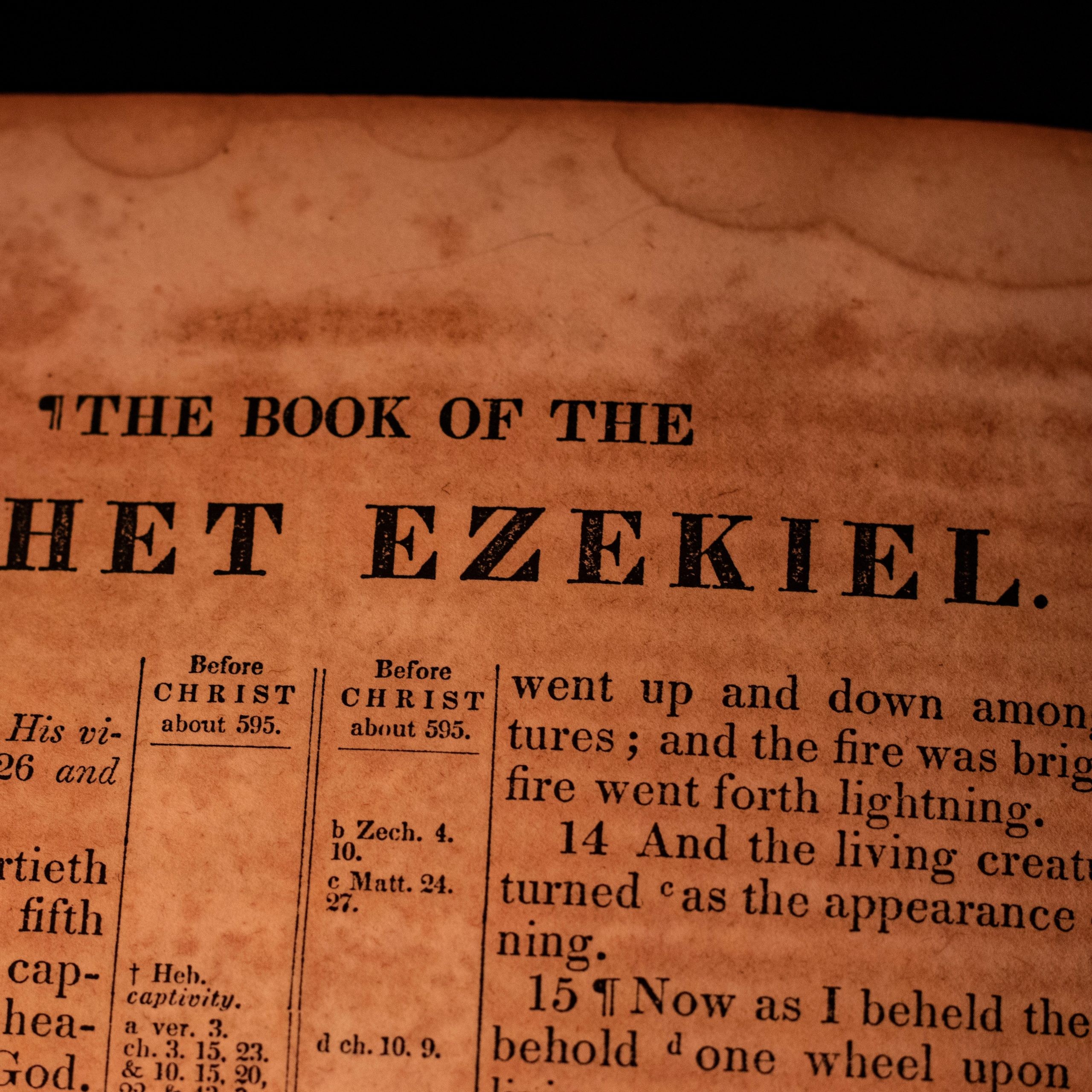
[00:02:02] Speaker A: This week? We are talking about Ezekiel,
[00:02:04] Speaker B: Zeke.
[00:02:05] Speaker A: And poor Ezekiel only gets one week.
[00:02:09] Speaker B: That's all right. Zeke.
[00:02:11] Speaker A: Yeah.
[00:02:12] Speaker B: What does Zeke mean? What's the name mean? What does Ezekiel.
[00:02:15] Speaker A: God will strengthen.
[00:02:17] Speaker B: Whoa. Really?
[00:02:18] Speaker A: Chazak is to strengthen. The E in front is actually the Yod Yitzchak, and it means he will strengthen. And El is referring to God. L.
God will strengthen.
[00:02:29] Speaker B: It's awesome.
[00:02:31] Speaker A: Yeah. Ezekiel is kind of a reluctant prophet.
[00:02:36] Speaker B: All the good ones are.
[00:02:38] Speaker A: Yeah, it seems like we run into quite a few that are like, don't pick me, Lord. I mean, you have that hinnony shelachani, like, here am I. Send me. And then you have the boy. What were you thinking, God? I am not the right choice for this.
And Ezekiel kind of takes that a little bit more extreme than the other Ones do.
Yeah. Some of them are just like, I'm slow of speech or I'm young or I'm going to give you a couple excuses for why you shouldn't.
Ezekiel is just bitter a little bit.
[00:03:10] Speaker B: Okay.
[00:03:10] Speaker A: In fact, let me give you a little context. Chapter three.
And so.
Well, first maybe let's set the stage with the timeline, right? When is Ezekiel? What's going on? Ezekiel is a little bit at the same time as Jeremiah, but he's a little bit after Jeremiah.
So Jeremiah prophesied that Jerusalem was going to be destroyed.
And around 600 BC, maybe a little bit before 600 BC, Babylon comes in and takes out a lot of the upper class and deports them, but leaves most of Jerusalem intact. And it's going to stay intact for the next all the way until 586 BC.
Ezekiel is a prophet from some of those in the very early deportations. And it's not necessarily Babylon, but another city that they got deported to. And he is going to prophesy to deported Jews about why they need to repent and how Babylon is going to be over them for a long period of time.
And that is where he fits in in things. So he's going to see Jerusalem destroyed, He's going to prophesy that Jerusalem is going to get destroyed. He's going to prophesy of the deportation of the rest of Jerusalem and he's going to prophesy that they are going to be there for 70 years and that they better get used to Babylon because that's their future.
So very similar with Jeremiah, but he is outside of Jerusalem. He is part of deported. And if you remember from what Jeremiah was saying, he said that there were a lot of prophets among the deported group that were prophesying that this wasn't going to last, that they would be able to come home, that Jerusalem would be preserved. So there was a lot of false prophets that he was going to be dealing with. And that gives us a little bit of context into his calling and what he's going to do.
[00:04:57] Speaker B: Tell her.
[00:04:58] Speaker A: So let's get into chapter three and I'll, I'll back up to chapter one in a minute. So if you guys are thinking, they're like, wait, wait, what about that weird four headed creature?
[00:05:07] Speaker B: Oh yeah, we're talking about foreheads today.
[00:05:09] Speaker A: We're going to talk about foreheads today. A tetramorph.
[00:05:13] Speaker B: Wow.
[00:05:14] Speaker A: Yeah, yeah.
[00:05:15] Speaker B: Wasn't in that. Was that in the Avengers?
[00:05:20] Speaker A: I don't know. Was there a tetramorph in the Avengers?
[00:05:22] Speaker B: I Just remember there was some square that they had to like get to time or something.
[00:05:26] Speaker A: Yeah, no, I know what you're talking about.
I do know the tesseract. Yeah.
[00:05:33] Speaker B: This is not the same thing.
[00:05:35] Speaker A: Different thing.
[00:05:36] Speaker B: Are we sure?
[00:05:37] Speaker A: Yes.
[00:05:37] Speaker B: Okay.
[00:05:38] Speaker A: Yeah.
So chapter three, God's giving him his mission here, verse four. And he said unto me, son of man, go get thee into the house of Israel and speak my words unto them.
And you know, for any of you who have been called on missions to serve English speaking missions or to your own country, you might find some comfort in reading verse 5 here. For thou art not sent to a people of a strange speech and of a hard language, but to the house of Israel.
And that was his mission.
And it gets kind of interesting in verse 6. Not too many people of a strange speech and of a hard language whose words thou canst not understand. Surely had I sent thee to them, they would have hearkened unto thee. But the house of Israel will not hearken unto thee, for they will not hearken unto me. And all the house of Israel are impudent and hard hearted.
So he's got kind of a tough mission. It's similar to the mission of Jonah. And we'll talk about Jonah soon enough here. This year we're kind of running out of people to talk about, but he is one of them still on the to talk about list.
[00:06:45] Speaker B: How have we not talked about Jonah yet?
[00:06:46] Speaker A: Right, we keep mentioning him.
[00:06:49] Speaker B: It just feels like he's a staple.
[00:06:51] Speaker A: He's on his way.
[00:06:54] Speaker B: All right.
[00:06:55] Speaker A: But similar to Jonah, Jonah gets sent to a people that are a foreign language of a foreign nation. And sure enough, they do repent for him where Israel would not repent. And, and that's kind of the deal here. And Jonah didn't want to go, as we remember, he tried to run the wrong direction.
And Ezekiel is very similar. So this is where we're going to see it.
And sorry, I got to flip the page.
[00:07:22] Speaker B: Flip it.
[00:07:23] Speaker A: Here it is flipped verse 14. So the Spirit lifted me up. So first off, he's not even going to get Jonah's chance to run the wrong direction. And for context here, Jonah prophesied about 200, 150 somewheres in there years earlier than Ezekiel. So maybe the Lord looked at Jonah turning and running the wrong direction and he's like, yeah, I'm not going to risk it this time. I'm just going to pick him up by the spirit and send him in exactly where he needs to go.
So the spirit lifted me up and took me away. And I went in bitterness. Now, the Hebrew word for bitterness here is. It's not just bitterness, it's anger.
It's not. I mean, not being very happy. Bitter about it, upset about it. Right.
Bitter anger and pain.
[00:08:19] Speaker B: Okay?
[00:08:20] Speaker A: And then in the next little deal, I went away in bitter anger, pain in the heat of my spirit. And so in the Hebrew here for heat is hot, displeasure, indignation, wrath. And this one's really good, Nate.
Burning anger.
[00:08:39] Speaker B: Wow.
[00:08:40] Speaker A: So he went bitter and in burning anger of his spirit.
And now look at the very last line here. But the hand of the Lord was strong upon me.
So he was carried up by the spirit. And he was really upset that he was lifted up by the spirit. Very bitter and upset about it, and mad.
But the hand of the Lord was firm upon him and carrying him into the place where he was going to set him. And so he sets him there. So verse 15. And I came to the captivity, then I came to them of the captivity of Tel Ab that dwelt by the river of Chibar. And I sat there.
I sat where they sat and remained there, astonished in this word for astonished, stunned, shocked, awestruck, kind of in disbelief among them for seven days.
And it came to pass, at the end of seven days, the word of the Lord came unto me.
So here he is, bitter, upset, The Lord has a firm hand and sends him anyways. And when he gets there, he just sits there dumbstruck for seven days, not saying a single word.
So if. If any of you have considered going on a mission, and then you think, you know what, Maybe this isn't for me and I don't want to go. And then the Lord's just going to say, look, you got to go. I mean, this is somebody that you can relate to. This is Ezekiel. He
[00:10:14] Speaker B: was. You got to go.
[00:10:15] Speaker A: He was pretty bitter about being forced onto a mission, if you will.
So much so that when he got to his mission field, he sat there dumbstruck for seven days, not saying a word.
That's Ezekiel.
[00:10:29] Speaker B: Okay, Zeke.
[00:10:31] Speaker A: And then the Lord's going to give him a little bit of counsel here.
So after he sits there for seven days, the Lord says, son of man, I made thee a watchman unto the house of Israel. Therefore hear the word at my mouth and give them warning from me. When I say unto the wicked, thou shalt surely die, and thou givest him not warning, nor speakest to warn the wicked from his wicked way to save his life.
The same wicked man shall die in his iniquity, but his blood will I require at thine hand.
Yet if thou warn the wicked and he turn not from his wickedness nor from his wicked way, he shall die in his iniquity. But you have delivered your soul, so go back to that scripture. If you labor all the days of your life and save but one soul, and maybe that's the only soul you save. Right. If you've done your job in warning the people and they repent not, you've at least saved yourself from. From their wickedness, because if they would have died and you hadn't warned them when the Lord asked you to, their. Their.
Their sin is now on you.
So God's saying, you know what?
You have agency.
You do what you want. You know, you're here.
[00:11:49] Speaker B: Kind of.
[00:11:49] Speaker A: Kind of
[00:11:51] Speaker B: like. Like, I brought you here.
[00:11:52] Speaker A: I did bring you here.
I'm. I'm going to see what you do. But. But. But. So, you know, if these people die and they didn't know that they were doing something wrong, it's on you. Your call,
[00:12:05] Speaker B: as that seems like.
Seems like a lot of agency.
I mean, if we're just being honest, you're
[00:12:12] Speaker A: overwhelmed with agency.
[00:12:13] Speaker B: Yeah.
For some reason, this strikes me as not a lot of agency, but. Okay.
[00:12:19] Speaker A: The opposite of agency.
[00:12:20] Speaker B: Yeah, but who am I to argue?
[00:12:23] Speaker A: Yeah.
I don't know.
You know
[00:12:26] Speaker B: what I mean, though, right?
[00:12:27] Speaker A: I know. I know exactly what you mean.
[00:12:28] Speaker B: It's kind of a. Hilarious. Like, I picked you up, I dropped you off, told you what you need to do, threatened you basically with eternal damnation. But, look, you can choose if you want to do it or not. So, like, oh, cool.
[00:12:44] Speaker A: Yeah. You know, and. And the problem. The problem with Ezekiel, you don't get a lot of backstory about what happened to him or his life before he became a prophet.
Why was he chosen? Why was he a prophet?
[00:12:57] Speaker B: He seems like a dude probably shouldn't have been chosen.
[00:13:00] Speaker A: And. And something profound that you've said is, is. Is some of the best leaders we have are the ones that never wanted to be the leader to begin with.
[00:13:09] Speaker B: I feel like that's actually a real thing. For whatever it's worth, I just think that there's a level of, like, sincerity and, like, I don't know, realness about people that get called to do something that they weren't necessarily trying really hard to get called to do.
I don't know. Does that make sense? Like, we all knew. We all knew the dudes on the mission, right, that just so desperately wanted to be the AP or a zone leader just so that, you know, they Could, I don't know, like, have it. Have a position of authority.
Which is funny because it's not like you ever had a special, like, set apartness to be the zone leader, you know, or whatever that was. Right?
[00:13:52] Speaker A: Yeah. But
[00:13:53] Speaker B: there. There was. It was just an annoying thing just to be like, are you being genuine? Like, are you being sincere? Like, what is your actual motivation in doing this?
I don't know. Those dudes were always just annoying.
[00:14:06] Speaker A: Yeah. For some reason. And. And it seems to haunt us in politics today. And maybe I shouldn't even go political, but.
[00:14:13] Speaker B: Oh, no, it's very political.
[00:14:14] Speaker A: It feels like the kind of people that have to brag about themselves.
[00:14:18] Speaker B: Oh, yeah.
[00:14:19] Speaker A: And I don't know how else you get into office, because if you're not. If you're. You
[00:14:23] Speaker B: have to sell yourself. You have to be an egomaniac on some level.
[00:14:27] Speaker A: Yeah.
[00:14:27] Speaker B: Narcissist on some level.
[00:14:31] Speaker A: And. And those are kind of the people that make you scared. But if.
[00:14:34] Speaker B: Yeah, they do.
[00:14:35] Speaker A: But if you don't open your mouth, I. You're not winning that position.
[00:14:39] Speaker B: Exactly what I mean,
[00:14:41] Speaker A: it's a little scary. It's a scary thought.
[00:14:43] Speaker B: Yeah, it's terrifying. It's terrifying because those are the people.
And the problem is, too, is that so many of these people are like, so, like, you know, well spoken and charming that you're just like, get out of here. But that they can easily get a bunch of people to, like, follow them in cult like ways. It's creepy, man.
[00:15:03] Speaker A: So if you can find somebody who's not narcissist, who's not gonna just be talking, because, I mean, that's a very interesting point. You look at some of the best that say I am slow of speech or I stutter. I don't like talking. I'm not long winded. I don't. I'm not charismatic. I mean, that's how I see a lot of these people describing themselves.
And here you have Ezekiel, who just doesn't want to talk, doesn't want to open his mouth. He's hesitant to do that.
That is the opposite of what you see with some of these other leaders. And so why does the Lord pick Ezekiel? Why does he pick him? And maybe there's something to be said about that humility in being shy or holding off. And why, obviously the Lord's not just stripping away his agency and making him go. I think Ezekiel had a sincere desire to serve the lor.
But when it comes down to calling people out for doing something that they're not doing right it's an intimidating thing. And especially people that are very agreeable, they don't like calling other people out and saying, hey, what you're doing is wrong. If he's introverted at all, pulling him out and forcing him to be ex.
I don't know. Maybe his.
[00:16:21] Speaker B: I see that.
[00:16:22] Speaker A: Maybe his innermost desire's heart was to really. I want to serve the Lord however I can. I desire to. And the Lord says, okay, then let me put you here now. Let me. Let me help you do what it is that you want to do. Let me. Well, his name means. And God strengthened him.
And here you have him getting the strength that he needed to say what he needed to say.
[00:16:47] Speaker B: Okay, I like that. Let's keep going.
[00:16:50] Speaker A: And speaking of the words that he has to say, even though it's going to be a hard message for his audience to hear and a very awkward, difficult conversation for him to have, yet he describes the words. Let's back this up a chapter. So we're kind of going in reverse a little bit when. When he gets called.
Actually, it's.
We don't have to back up the chapters. Verse 1 of chapter 3. Moreover, he said unto me, son of man, eat that thou findest. Eat this roll and go speak to the house of Israel. This is not a Texas roadhouse roll,
[00:17:23] Speaker B: okay?
[00:17:24] Speaker A: This is a scroll that has written on it. So this. I guess we do have to back up a little bit at the end of the chapter, verse nine of chapter two.
When I looked, behold, a hand was sent unto me. And when we say a hand was sent, the word sent is stretched out, okay? So a hand was stretched out unto him.
It was extended. It's probably the best way to say that. And lo, a roll of a book was therein.
And he spread it before me, and it was written within and without. And those who were written were lamentations and mourning and woe. So the warnings that he's going to have to be speaking is written on this verse 1. Moreover, he said unto me, son of man, eat that thou findest. Eat this roll and go and speak unto the house of Israel. So I opened my mouth and he caused me to eat that roll.
Kind of an interesting relationship with God. I'm going to pick you up, send you over here, and I'm going to shove this roll in your mouth.
[00:18:17] Speaker B: The story just keeps getting more and more agency.
[00:18:21] Speaker A: Oh, yeah,
[00:18:23] Speaker B: I'm sorry. I'm just calling it like I see it, man.
[00:18:26] Speaker A: Call it like you see it. I. No problem. You know what
[00:18:28] Speaker B: I mean, though? Yes, even more and more. It's just kind of like, no, you're gonna do this,
[00:18:33] Speaker A: and. And then. And maybe that's how God strengthens us, you know? How do I learn how to swim? Just a second. I'm going to throw you into that pool, and you'll figure it out real quick.
[00:18:41] Speaker B: Move your arms for you. All right.
[00:18:44] Speaker A: Verse 3. And he said unto me, son of man, cause thy belly to eat and fill thy bowels with this roll that I give thee. Then I did eat, and it was in my mouth as honey for sweetness. And John describes the same thing in the book of Revelations when he eats the book, and he says that it was really sweet, the words of it.
So I think sometimes the message of God and the words that. And it's interesting because he's saying consume. And so coming in through the mouth and having to consume at first through the mouth is interesting because now he's going to have to be opening his mouth and it's going to be coming out of his mouth as he speaks to these people.
And the word of God, it's got to be sweet.
When you think of the chance that if a wicked hears this and they can take and heed it and change, you can save a life. Is there anything sweeter than that?
Is there anything sweeter than knowing that Christ has atoned for you and he is giving you a chance to save yourself and to find your soul? These are very sweet, comforting things.
And maybe this is Ezekiel's desire. And it's sweet to him because he loves the word of God and he loves the opportunity to preach or to save people. And he's fit for this role that he's very intimidated to have these difficult conversations with people that aren't going to listen if they're listening. Maybe he's all on board, but he's so nervous about. I don't know. It's just an interesting situation to see this man, and it brings a little bit of personality. Personality back to who he is.
[00:20:23] Speaker B: Okay,
[00:20:26] Speaker A: should we. Should we. Should we make it even a little bit stranger?
[00:20:29] Speaker B: Why not, man?
[00:20:30] Speaker A: Let's back it up to chapter one, then.
[00:20:31] Speaker B: All right, here we go. Tesseract,
[00:20:36] Speaker A: verse one. Now, it came to pass in the 30th year of the fourth month, of the fifth day of very specific of the month, as I was among the captives by the river of Chebar.
So when you talk about the Lord picking him up and carrying him next to the river Chebar, like he's already there. It's not like the Lord is Teleporting him across the globe.
[00:20:57] Speaker B: See, I didn't know that.
Why not?
[00:21:00] Speaker A: He's got a firm hand on him and just kind of marching him maybe outside of his room into a. A public gathering, people are going to be.
[00:21:09] Speaker B: See, Because I was like, did the Lord teleport him?
[00:21:11] Speaker A: Yeah. No, but.
[00:21:12] Speaker B: Well, I'm glad to know that that didn't happen because that helps me not feel so weird about, like, oh, but it's your choice. Like, like, had he been teleported, I'd have been like, okay. Actually, no, it's not. It's not his choice.
[00:21:23] Speaker A: And maybe teleportation is the least of our concerns here. In this next year,
[00:21:27] Speaker B: do you think I could bless a baby with the gift of teleportation?
[00:21:29] Speaker A: Nightcrawler, this episode's getting off the rails.
[00:21:36] Speaker B: That's what I'm here for, baby.
[00:21:37] Speaker A: I like it. All right.
In the fifth day of the month. It was the fifth day of the year of King Jehoiakin's captivity.
The word of the Lord came expressly unto Ezekiel. It's kind of interesting. They don't usually add this adjective in here.
And for the record, chapter one here is very extremely visual.
It says appearance 15 times, likeness 10 times.
Yeah.
And you know how, you know, it just hit me. Nate,
[00:22:12] Speaker B: tell me,
[00:22:12] Speaker A: know how we're. I. I'm. I'm saying maybe Ezekiel's a little bit introverted or hesitant to talk to these people.
Look, look at, look at verse.
Sorry, just scrolling here.
Verse 28. So it's the last verse of this chapter.
As the appearance of the bow that is in the cloud of the day of the rain, so was the appearance of the brightness round about it. Now, this is the sentence I want to get to. This was the appearance of the likeness of the glory of the Lord.
[00:22:49] Speaker B: It's like inception level deep there. Like four.
[00:22:53] Speaker A: Yeah, right.
[00:22:53] Speaker B: Four levels of likeness.
[00:22:55] Speaker A: This is the appearance of the likeness of the glory of the Lord.
So you're not like, how non committal is he on this?
Right? Because the very next line, and when I saw it, I fell upon my face, and I heard the voice of one that spoke. So here.
Why didn't he just say there was the Lord sitting on his throne? And when I saw the Lord, I fell down and worshiped him. But here he is almost very hesitant, right?
He's not using words of certainty.
He's not proclaiming a lot of self confidence.
It's the appearance of the likeness of the glory of the Lord.
He's very hesitant to just Come out and say that he saw the Lord, and maybe that reflects some of his personality.
[00:23:48] Speaker B: Okay?
[00:23:50] Speaker A: But what he does see, and it's interesting, he notices it was the fifth day of the month, and the word of the Lord came expressly to him in the land. And then let's get into this visual verse four. And I looked at. And behold, a whirlwind came out of the north.
Now, remember, the word north here in Hebrew. This is Saphon, and Sapphon is the mountain of the gods in the mythology of this time period in this place of the world, this region, it is like Mount Olympus to the Greeks.
So when you're talking about it coming from the mountain of the gods, a great cloud and a fire enfolding itself, and brightness was about it. And out of the midst thereof was the color of amber. Out of the midst of the fire.
Now, this word that was translated as amber, it's close, but it has a metallic quality to it. So it's not like this clear orange, see through.
It's more like burning metal. Like it's. It's. It's a. It's got a metallic luster. It's a glowing red.
More. More like something heated up in a forge.
[00:24:55] Speaker B: Okay.
[00:24:57] Speaker A: And so you've got this cloud, and out of the midst thereof came the likeness of four living creatures. And this was their appearance. They had the likeness of a man. Okay, so we've got four creatures that look like a man, and everyone had four faces.
See, I don't know very many men with four faces, but we'll read on.
And everyone had four wings.
I don't know a lot of guys with wings either, but.
And I've got something to say on wings. Let's circle back around to the wings in a second, though,
[00:25:30] Speaker B: okay?
[00:25:31] Speaker A: And their feet were straight feet, and the sole of their feet was like the sole of a calf's foot. So now they have hoofed feet, and they sparkled like the color of burnished brass.
And they had the hands of a man under their wings on their four sides. And the four had four faces and their wings. Okay, let's talk maybe just a second about wings for a second, because we're talking about their hands that are coming out of their wings. And that seems a little bit weird.
So if I did a word search on the word wing knoph, it means a flap, a skirt, a cover, a robe, a border, and it also means a wing.
And every time it's talking about birds, they typically translate it as wings. But every time it is talking about man, you are typically talking about their skirt, their corner, or their blanket. So let me give you some verses.
Numbers, chapter 15, 38. Speak unto the children of Israel and bid them that they make them fringes in the.
And then this word, you could say wings, if you will, of their garments is translated as border.
So on the edges of their garments, in the corner of their garments, put the fringes in it, not necessarily wings. Deuteronomy 22:30. And a man shall not take his father's wife, nor uncover his father's.
And at this time, they translated it as skirt.
Ruth 3, 9.
And he said, who art thou? And she answered, I am Ruth, thy handmaid. Spread therefore thy skirt over thy handmaid. So we talk about this skirt. Even skirt doesn't quite seem right. Thy covering, thy blanket, right? And if you're uncovering your father's blanket, you're uncovering his wife. And here he's saying, take this blanket and cover me with it as well.
So typically, when you're talking about a man, and there's a couple more verses, we could go through David, when he runs into Saul, he cuts the corner off of Saul's.
Not wings. They take that and they translate it as his skirt.
And same thing, when Samuel goes to leave and Saul's like, oh, come back. And he grabs it and tears his wings.
Nobody takes that and translates it as wings and says, samuel had wings that Saul pulled off. It's his robes, his garments. So coming back to these figures, when they say it, it has the appearance of man.
Usually this word is not translated as wings in association with men.
It is translated as a skirt or a robe or a covering. So when he says they have hands coming out of their wings, I look at it and say, that is probably sleeves.
They are robes, they are garments that they are carrying. And you have got two sets of wings. So there are four. And I look at it as two sleeves and then probably another set that they are all bound to a cloth, that they are all.
So you have one cloth that links the four creatures together, and then they have another cloth underneath that they are wearing that covers their arms and their body. So like a robe or a garment.
So you can read it as wings. You can read it as a garment or a cloth. And when we talk about garments and covering, that also has significance when we talk about atonement and whatnot.
[00:28:58] Speaker B: Okay,
[00:28:59] Speaker A: going back to them, these creatures have each one of them four faces.
The face that's facing towards him. So coming from the north, this would be the southern face is the face of a man.
And then on the right side, so this would be the east face, the face of a lion. The north is the face of an eagle. And then they had the face of the ox on the west side, at least the one facing him. I don't know if it's the same orientation for each one because it's not quite that specific.
But you have this four headed creature, or at least one head with four faces, man, and then a lion, eagle and an ox.
And that seems so strange.
And the thing about the four faces is they can travel only forward.
So this being does not turn, it will only travel.
And because there's four of them, they all travel in sync together, but they only travel in the direction of a face. So they can travel left, right, backwards, or forwards. But it also says they can go up and down, but they don't turn. So if they need to come at a diagonal, they're going to go right and then they're going to go down, or they're going to go left and then up, or however it's going to be.
And that way they don't have to turn. They're just going whatever direction, whatever face is facing them, which is kind of weird. And next to them you have a wheel that's facing forward, so it can go forward and backward. And then you have a wheel that's facing sideways, so you can go left and right. And you have four wheels outside of these four creatures. But they said that this living creature, the spirit of the living creature, controls the movement of the living creature and the movement of the will. It's the same spirit that controls both of them at the same time, for what it's worth.
So this is what Ezekiel's seeing, and he's explaining this in a bunch of great detail.
And this is what he's noticing.
And so I guess the big question is, what in the world is he seeing?
What does it mean?
And I think a lot of people try to get caught up in the symbolism of it. All right, According to Ezekiel, this is a living creature.
It's not symbolic of anything. It's actually something that's alive that exists. And I wonder if the point of God, because where do we see this? A theophany, they call this. So theo means God. And the phoney part is a manifestation of. So theophany means a manifestation of God. There's lots of manifestations of God in the Old Testament. He appears to Moses, but he doesn't typically appear to Moses with this much visual detail outside of just describing his personal Appearance.
So what does it all mean?
Why does Ezekiel see it? Where is this going? Where are we going with this? Is this some kind of weird UFO or technology we've never seen before? What's.
I don't know.
Where do you want to go with this, Nate?
[00:32:13] Speaker B: Aliens.
[00:32:14] Speaker A: Aliens.
I mean, that's.
You're actually probably spot on.
[00:32:20] Speaker B: That's right,
[00:32:22] Speaker A: because they do say it's a living creature
[00:32:24] Speaker B: building pyramids, dude.
In both the Middle east and Central America. It's. The only answer it could possibly be is aliens.
Whatever, man.
I've watched the History Channel.
[00:32:38] Speaker A: Well, see, you had me at first. You lost me as soon as the History Channel and those ancient aliens came into play.
[00:32:47] Speaker B: Ancient aliens. Oh, my goodness. All right, so what do you think it is?
[00:32:53] Speaker A: I think one. So I've got two main thoughts on this.
The first is you have so many false prophets that are telling the people that things are going to be fine, that Babylon's going to fall apart, and they're going to be able to go home, and they're all speaking in the name of the Lord. God told me to say this. Thus saith the Lord. We're going to be. Whatever.
So if Ezekiel is going to be speaking in the name of the Lord, how does that distinguish from any of the other false prophets that are saying, thus saith the Lord?
Right.
And for him to be describing this in great detail, how do you make something like this up?
Not only is it extremely detailed, but it's describing something that no one has ever seen before, and it's something that's not of this world.
So God is bringing something from where he is, something that is alien. I mean, you said it kind of in jest, but it's spot on.
I think the point of it is it is foreign. You are not supposed to know what it means. You're not supposed to understand it, because it's not from this world. It's nothing we're familiar with.
I think that's it. And I think the other part of this is it's a huge distraction.
You look at Ezekiel and how much time and attention he gives in seeing all of this, that he missed the Lord.
He's so caught up looking at the wheels and the creatures and describing them and how fascinating and all of this and all of what it is that he doesn't even. And when he does see the Lord, as we said, it's the appearance of the likeness of the. Oh, my goodness. That's the Lord.
And now all of a sudden, he's falling down, and he's worshiping. Why wasn't he falling down and worshiping from the beginning? Because he was so caught up in seeing everything. And what is its position to the Lord? The Lord is sitting on a throne above this, and the Lord is saying all of you. And I think it's fascinating, to this day you have all sorts of people that are still guessing on the interpretation and what this means and what it is attached to. And they're so lost on trying to understand this.
But what was the message that the Lord gave Ezekiel to speak to the people?
How many people can tell you what Ezekiel said, what the prophecy was, what the Lord said? Are we focused so much on the creatures that we missed the message that the Lord brought?
And you look at the people and the Jews, they missed the mark. And it talks about how they missed the mark. And they're so caught up in different things that they missed the point. And we've brought this example so many times. I love this from the New Testament. Peter walking on the water that he got so caught up in the wind and the waves around him that he lost his focus on that which was most important.
So when I look at these creatures and it seems confusing and I feel like I'm lost.
One, I think that's the point because they're not from this world. And two, it's a sign that we keep missing the point because we keep focusing on things that are below the Lord that really don't matter.
Sometimes we get so caught up in politics that we're just going to do it one way and it has to be this way. And we think that this is what's right. And now all of a sudden we're trying to make that a new religion for us. And it doesn't have to be politics. It could be anything.
Sometimes we obsess to such a degree that this is the only right way to do that, or this is what the Lord wants, and we've hyper focused on what's below the Lord and replaced God with something that's foreign or distracting or out of place.
[00:36:57] Speaker B: Cool. Let's keep going.
[00:36:58] Speaker A: Okay, we'll skip. If we've got time, we can circle back to some of these other chapters, but we're going to go into 33.
And just as the Lord talked to Ezekiel about how if these people don't repent and you warn them, it's on them, but if they don't repent and you never gave them a chance, that's actually on you, it's something that's going to be repeated and we're going to see this in the Come follow me discussion. We pull into chapter 33, and it's the same type of thing, verse one.
And again, the word of the Lord came unto me saying.
And it's nice that it starts with again, because this is a repetition.
And sometimes we complain and say, oh, we've heard this before. Or. It's very repetitive.
Yeah, it is. It's supposed to be, son of man, speak unto the children of thy people, and say unto them, when I bring the sword upon a land, if the people of the land take a man of their coasts. So when we say coast, we're talking about their borders, the fringes, the outside of the town where the wall is, so that they can. It says in the next line, and set him for their watchman. So you take someone who is on the outside and you put him up as a watchman so he can warn everybody on the inside.
And when he seeth the sword come upon the land, he bloweth the trumpet and warn the people. Then whosoever heareth the sound of the trumpet and taketh not warning, if the sword come and take him away, his blood shall be on his own head.
If you have been warned and you don't do anything about it, your fault.
He heard the sound of the trumpet, he took not warning, his blood shall be upon him. But he that taketh warning shall deliver his soul. But if the watchman see the sword come and blow not the trumpet, and the people be not warned. If the sword come and take away any person from among them, he is taken away in his iniquity. But his blood will I require at the watchman's hand. So thou, O son of man, I have set thee for a watchman unto the house of Israel. Therefore thou shalt hear the word at my mouth and warn them from me.
I don't know that we need much more explanation. It's the same message that he gave to him in chapter three, but it was worth repeating.
Skipping forward to verse 12. Therefore, thou, son of man, say unto the children of thy people, the righteousness of the righteous shall not deliver him in the day of his transgression. If you just stop there, that might seem a little bit weird.
The righteousness of the righteous won't deliver him in the day of his transgression. Then what's the point of being righteous?
But bear it out. As for the wickedness of the wicked, he shall not fall thereby in the day that he turneth from his wickedness. Neither shall the righteous be able to live for his righteousness in the day that he sinneth. Now it's talking. And it's sad that I'm going to pick on David because he's probably the best example for this.
David was a righteous man who slew Goliath, who had the respect for Saul as the Lord's anointed, who didn't slay him when he had the chance, who tried to do everything that the Lord asked him to do and tried to rule in righteousness.
But for all of his righteous behavior, how can you go and stand before a judge and you slay Uriah the Hittite and say, yeah, I did slay him, but let me just recount all of the righteous things I did and that will be okay. Like I can use my righteousness as a covering for what I'm going to do now or what I did, right?
So it's not to say being righteous doesn't matter.
It's very important to be righteous.
But you can't use your righteous past to justify not being righteous today.
Nothing you did in the past matters as much as what you do in the current moment. Now.
And on the flip side of the coin, a wicked man, you can't go and say, look how bad this guy was and hold that against him forever if he stopped being wicked and decides to choose righteousness. And if you want to take another example from the Bible, I mean, we can look at Saul and maybe it's hard to say Saul was a wicked man, but he says he persecuted the Christians, he said he did things that he was ashamed of, and whatever wickedness is being held against him. Or Alma the Younger, if you're looking at the Book of Mormon, when you see a wicked man turn from his ways and be righteous, how can you hold that wickedness against him? And the point of these verses is to say nothing matters so much as what you choose to do in the now.
You can't say, I've been so righteous the past five years, I deserve a break because I always went to church, because I always tried to help people, because I was always trying to do the right thing.
I can take five right here and I can go on a binge and I can do everything that I felt like I was being withheld from by my righteousness and indulge in whatever guilty gratification or sin for these next few minutes until I can kind of, because I've got enough back points saved up to cover this, that doesn't work.
But I think that's probably mostly self explanatory
[00:42:30] Speaker B: love It.
[00:42:30] Speaker A: Anything you want to add, Nate?
[00:42:32] Speaker B: None.
[00:42:33] Speaker A: None.
[00:42:33] Speaker B: Let's keep going.
[00:42:34] Speaker A: Okay.
Which. Which is a. It's a beautiful message for all of us because all of us, I'm sure, have plenty of wickedness in the past. And verse 16 becomes very peaceful.
None. Verse 15. Let me back up. If the wicked restore the pledge, give again that he had robbed. And so this.
I think this is very important when they talk about a wicked turning away from his ways, because it's not just the simple fact that from this day forward, I'm going to start doing what's righteous, but they're actually going to outline a few steps. So verse 15. If the wicked restore the pledge, give again that he had robbed. Walk in the statutes of life without committing iniquity. He shall surely live. He shall not die. None of his sins that he hath committed shall be mentioned unto him. He hath done that which is lawful and right. He shall surely live.
So I want to break this down into two parts. First, the steps that are going through here, restoring, making it right. Give again that which he had robbed. It's not just enough that you're saying, I'm done. You got to figure out how to fix it.
You got to try to make it right. You got to talk to somebody. I'm sorry I wronged you. What can I do to make this right?
Walk in the statutes of life without committing iniquity. So stop doing what it was, and then he shall surely live and he shall not die.
But I love the legal aspect of this. In verse 16, when he says, this is the second part I want to hit. None of his sins that he hath committed shall be mentioned unto him. He hath done that which is lawful and right.
You look at it and say, well, he broke the law. How can you say that that's lawful? Not necessarily. Look at the legality of it. If it says if you break the law, then you have to pay a $500 fine and spend 30 days in jail. And so you broke the law, you paid the fine, and you spent 30 days in jail. What law did you really break?
You fulfilled the law, and so you weren't unlawful at all.
You said, okay, this is what I did, and now this is what I'm doing to make sure I follow the law. And in the end, you were just as law abiding as someone who never did it because you fulfilled the terms of the law that was in place.
So I like the legal aspect of it that at the end of the day, when we make things right, we have completed the law. You do not have to look at it as a rule breaker.
You might have done it differently, but. But the law was still fulfilled and how you paid that price.
All right, flipping the page.
The shepherds in 34.
When you talk about the leaders of Israel, Nate, this is going to go right with where we started with, on what makes a good leader. And we talked about Ezekiel not wanting to be the leader.
It's the shepherds. When we talk in 34, son of man, prophesy against the shepherds of Israel. Prophesy and say unto them, thus saith the Lord God unto the shepherds. Woe to the shepherds of Israel that do feed themselves.
Should not the shepherds feed the flock?
You eat the fat and you clothe with the wool. You kill them that are fed, but you feed not the flock.
So if you ever want to check and find out what makes a good leader and what doesn't, if the leader is taking advantage of the flock to clothe himself, to feed himself, to do everything. So what is the leader's focus in mind? Is it self interest? Is it, how do I gain from this position?
Or is it how do I serve this sheep?
And this is where it went all the way from the beginning, right? When we look at Christ, they looked at him and said, hey, you are the greatest. I should be serving you. And Christ says, no, if you want to be the greatest, you have to learn how to serve others. That is what a leader is.
And take it even before, with Christ coming into the earth, look at the difference of plans between Satan and Christ. When Satan says, I will be the greatest, I will make everybody obey. I will make everybody worship me because I will make it all right versus Christ saying, no, I will give the people the liberty. I will serve them. I will give them the ability to choose and let them do what they are going to do, because I have their best interest in mind versus my best interest in mind.
So that's Ezekiel.
[00:47:19] Speaker B: Good work, Zeke.
[00:47:20] Speaker A: Okay, we have. We have one last chapter. Sorry I said that's Ezekiel, but
[00:47:25] Speaker B: okay,
[00:47:26] Speaker A: I didn't mean to wrap up all of the Ezekiel. I just meant to say
[00:47:30] Speaker B: that's who our man's is.
[00:47:31] Speaker A: That's our man's nature. That's. That's the reluctant leader. That's. That's our prophet.
The last. The last is Ezekiel 47.
But the problem with starting in 47 is you miss all the context of 40 through 47. It kind of cuts in at the very tail end of. Of some important context. So I'm going to back it up to 40, give you a little bit of context. Finish up with 47 and then we'll see if there's anything we missed. Kind of wrap this up.
[00:48:01] Speaker B: Okay.
[00:48:03] Speaker A: Chapter 40. So Ezekiel's already seen some pretty crazy things. The living creatures and the whales and whatever UFOs coming out of heaven with. With Christ sitting on a throne on top of it, right?
So when he sees visions, he sees some pretty grand things.
Verse 1 of chapter 40. In the fifth and twentieth year of our captivity, in the beginning of the year, in the 10th day of the month of the 14th year, the same after the day the the city.
After that the city was smitten, and the self same day, the hand of the Lord was upon me and brought me thither. So again, the hand of Lord's taking him and bringing him to a different location.
And you'll notice the language here when he's talking about. He's already been captive.
The 20th year of their captivity, this is the city of Jerusalem was destroyed. So he was carried out, as we said in the beginning, before Jerusalem was destroyed, in that earlier group that was carried out captive.
So here he is, he's carried up by the Lord. And the visions of the Lord brought me into the land of Israel, and he set me upon a very high mountain by which was the frame of the city of the south.
So here he is, the hand of the Lord grabs him again and carries him. But this time, instead of a large audience of people who he might be intimidated to speak with, he's carried up into a high mountain. You're thinking, oh, boy, he saw these creatures, and he's not having to speak to this crowd, what is he going to see? And he brought me thither. And behold, there was a man whose appearance was like the appearance of brass, with a line of flax in his hand and a measuring reed. And he stood at the gate. And the man said unto me, son of man, behold with thine eyes and hear with thine ears, and set thine heart all that I shall show thee.
And that's important when this idea of witnessing and testifying to see with your eyes and hear with your ears.
But he says to him next, and behold, a wall on the outside of the house, round about. And there in the man's hand, a measuring reed of six cubits long by the cubit and a hand breadth. So he measured the breadth of the building, one reed and the height, one breed. Then he came into the gate which looketh to the east, and Went up to the stairs thereof, and he measured the threshold of the gate, which was one reed broad, and the other threshold of the gate, which was one reed broad. And this is going to go on for the next six chapters or so.
Not, not, not the most exciting. There's no fiery creatures and beasts and monsters. It's a guy with a measuring tape and he's measuring. What he's going to be measuring is the dimensions of a temple. And this is after the temple was destroyed. So he's measuring a temple that's either going to be restored or built down the road.
And we have talked about measuring. So maybe it is just a very quick note at this point to remind you guys, when we talk about creation and the order and building things, the Lord says that he wants to use us as pillars in his tabernacle. Never more to go out. We are the building materials. And in order to be the building materials, building requires specific measurements. And so if you measure a board that is going to be 96 inches long and say it is 98, and you cut off two inches, you don't throw away the 96 inches and keep the two leftover scrap. You keep what measures up and you throw away what does not.
And so the Lord has given us very specific measurements in the form of commandments and direction. And as he provides those measurements to us, we become useful as we learn how to follow those measurements, to fulfill the law, to make things, things right. And as we do that, we become the building material into the house of God. And so it is important, because the building of the temple is not just a physical building of a temple. It is also symbolic of the restoration of his people, bringing them back together as they start to meet the measurement. Because here, early on, they do not meet that measurement. They have changed the statutes, they have changed the commandments, they have broken the law.
So we can't use them as building material. We are going to have to throw them out. They are going to get destroyed. They are going to be unless they repent, unless they start measuring up. And now that they start to measure up, it is going to become useful. And we are going to use it to build and restore the temple. And it is symbolic of not just the restoration of the temple, but the restoration of the people of God.
That being said, let us fast forward to chapter 47.
The chapter that come Follow me wants us to talk about.
And. And what we see is from this temple that has been rebuilt and restored and measures up, water is going to proceed from the temple. And this water is going to start as a small trickle and it's actually going to get deeper as it goes deeper and deeper and deeper until it gets to the Red Sea. And when it gets into the Red Sea, it's going to heal.
I am sorry, I said Red Sea. I meant Dead Sea. It is going to heal the waters of the Dead Sea and make it so it is not just a salt lake that can't preserve life, but a fresh water lake that is going to preserve life.
So maybe we should just ask the question here. What is the symbolism of that? What is the symbolism of water coming from the temple? What is the symbolism of the water getting deeper instead of more shallow?
What's the symbolism of a Dead sea becoming a fresh lake?
And I mean, what can we take away from this last chapter of Ezekiel?
And before I dive in, I'm going to put the hand of the Lord on your shoulders, Nate, and put you in an awkward situation.
[00:53:53] Speaker B: Okay.
[00:53:55] Speaker A: Do you have any thoughts?
Open your mouth, Nate.
[00:53:59] Speaker B: I mean, I got. I have. I have ideas, but I.
[00:54:02] Speaker A: You're artistic, Nate. You see things and you have some really profound thoughts. I mean, what do you think the artistic value, what is the symbol? What is the power of that?
[00:54:15] Speaker B: I mean, the idea of.
A sea that is going from like a salt sea or a dead sea to a fresh water sea.
I think the artistic visual for me is the idea that it's still water in both cases. Right. The nature of it is the same.
It's the makeup of the water that changes. It's either life taking or life giving properties. Right. And I look at that as a human being in a lot of cases, right? When somebody is born again or changed or converted or, you know, just generally, generally made new.
And a lot of that can be by a lot of the things that we consume that again, by nature the same, such as like technology or like the Internet. It's been talked about at conference a lot, Right. That it's. The makeup of the Internet is the same.
It's. Do you use it for things that are destroying your soul or do you use it for things that are uplifting and building? Right.
We talk a lot about the dual nature of things all the time. But I think that there's something that's kind of just interesting in the idea that a human being can be the same. Human.
The makeup of a human is the same. But when they're. When they're converted or changed, it's almost just like the changing of the miracle of water into wine is that through God somebody can be Changed.
I don't know.
[00:56:05] Speaker A: I like that.
And I can't help but think when we think of the Dead Sea, the reason it's dead is because it's salty, right?
Salt makes it so nothing can grow.
[00:56:20] Speaker B: Yeah, but salt's also a preserver.
[00:56:22] Speaker A: Yes. And the Lord tells his people, you are the salt of the earth, right?
But can you have too much salt?
And I wonder if the salt of the earth has become such an inclusive group that it's grown to be at toxic levels because they think that they are the only ones saved, or they think that they are the only ones that deserve being saved.
And how many times in the Old Testament did the Lord say, hey, so you know, the reason why I am going to destroy you is because you keep forgetting about these people that really need my help.
And you look at the message of Ezekiel like, hey, these people need to hear this.
These people need to hear.
You're not just.
These people are getting destroyed because there are strangers, widows, fatherless people that can't stick up for themselves, that are crying to me daily asking for help.
And the Jews who profess to love me with their lips and draw near to me in their outward are so far from me, because if they really loved me, wouldn't they be caring about all these people that are getting trodden down and beaten up?
And who is reaching out to them?
And Ezekiel, how are you any different from them? If these are thou the people that are in great need, these are now in the people that are about to be destroyed, unless you were to reach out and save them. And this idea that sometimes you get so comfortable with your own group that you are not willing to reach out and help these others, maybe this salt that is supposed to be the Savior, that is supposed to save the world, has gotten to be toxic levels and needs an infusion of some fresh water to dilute it.
Maybe there's an argument that can be said for inclusivity here.
I don't know.
[00:58:19] Speaker B: Cool.
I like it.
Go ahead.
[00:58:24] Speaker A: Oh, no, please, please,
[00:58:25] Speaker B: no. I was just going to ask if there was anything else you wanted to add.
[00:58:29] Speaker A: The reason why the Dead Sea is salty, and also the same reason why the Great Salt Lake is salty is because it has an inlet.
So water comes in, but it has no outlet.
There is no water going out.
And so the only way water can leave this lake is through evaporation.
And if the water is evaporating, then the mineral gets left behind.
And because the water keeps leaving, going through our whole transpiration cycle, turning into clouds of Moisture and raining somewhere else, it is always leaving.
What gets left behind is a higher and higher and higher concentration of salt. If you have a lake that has an inlet and an outlet, then the water comes in, but the water also is able to flow out with the minerals and moving water.
It says it in Doctrine and Covenants. How long can rolling waters remain impure or moving waters remain impure? If it is moving water, it is going to be fresh, it is going to be clean, it is going to be pure. So I also look at the Dead Sea or the Great Salt Lake because they are very similar lakes and them being healed as maybe there are two things that we can take from this. One is stagnant. There is no movement.
And, and when we, when we grow comfortable with where we are and we're not willing to challenge ourselves, we're not willing to learn, we don't keep moving. Because sometimes you think, I, I, I mean, if you've heard this right, you're, you're always moving either one direction or the other. So if you're not moving up, then you've got to be moving down. And, and we've got to find a way to constantly be gauged. Everyone should be anxiously engaged in a good work. If we're not being engaged, then maybe realigning. Building this temple is going to provide the waters that need to keep us moving, to keep us engaged in a good work or to heal us and to provide that salvation in one sense of the word. But the other sense is if we have an inlet and say that inlet is God's love in the sense that he is blessing us, he is establishing us, he is taking us as our chosen people and giving us all the love.
And if we look at the other as not having an outlet, is that if we keep taking and receiving all of that love from God, but refuse to turn around and share that love, there's no outlet of that love to give it to anyone else or to provide anyone else with that same love or care that we're receiving, then you see that same Old Testament problem where the strangers are being taken advantage of and the widows don't have anyone to stand up for them, and the fatherless, nobody's taking care of them, there's no outlet, then maybe that's the other issue.
I'm going to send so much love out your way that it's going to break that free and give you an outlet to care for the others and provide something there.
[01:01:27] Speaker B: Awesome.
All right. Anything else?
[01:01:34] Speaker A: I don't think so. I think I think I've probably said my piece.
[01:01:38] Speaker B: Great.
Next week,
[01:01:41] Speaker A: Daniel,
[01:01:44] Speaker B: when I first. I've got all of my. I've got all my tunes ready. Got all my Daniel tunes ready.
[01:01:50] Speaker A: Yeah.
You've been waiting for this for a long time. For
[01:01:54] Speaker B: this for a long time. Mostly just for the Daniel tunes, but the Daniel stories are great too, so. All right, until next week.
[01:02:01] Speaker A: See ya la.